
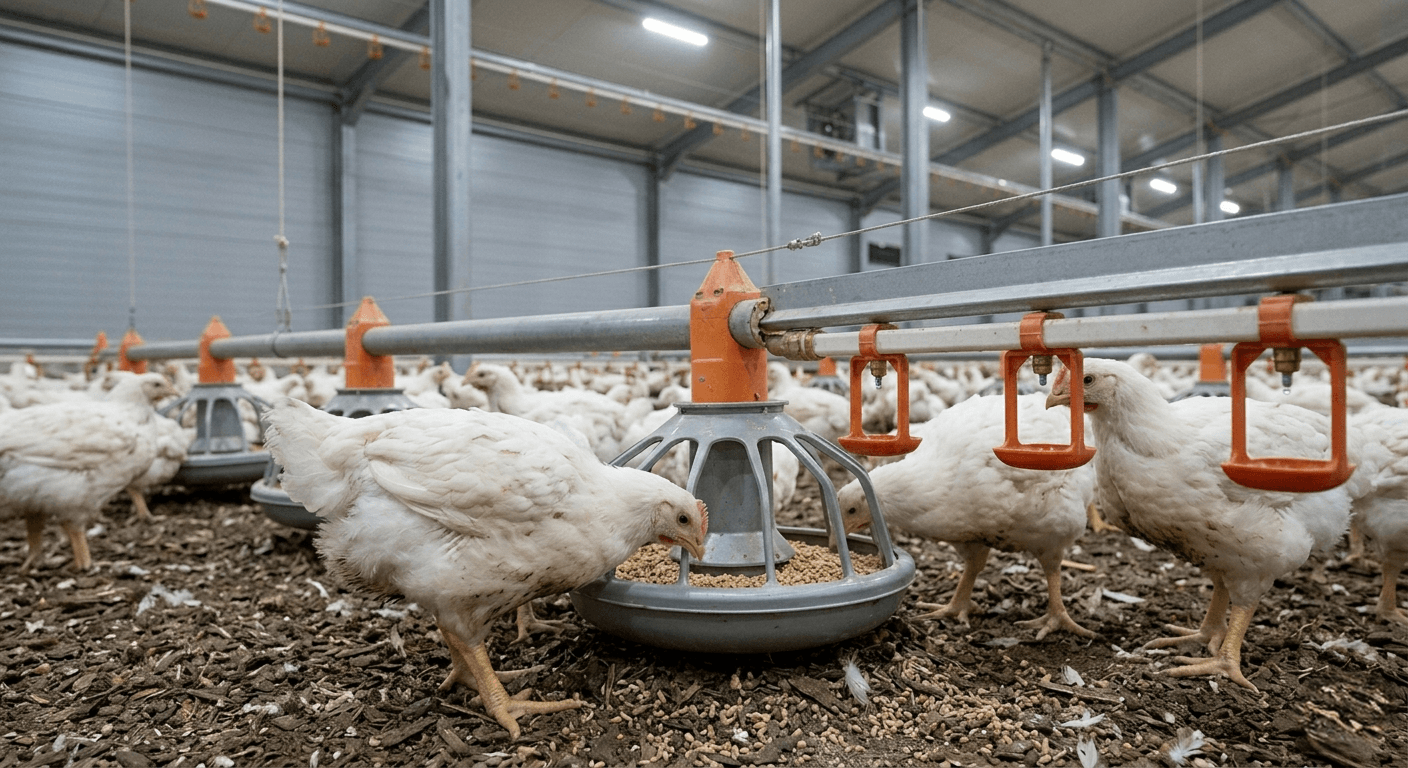
Indonesia’s commercial poultry industry (industri peternakan ayam di Indonesia) is entering a stage where efficiency and cost control matter more than rapid expansion alone. With feed costs remaining the largest component of production expenses and farm sizes continuing to grow, labour efficiency has become a critical factor in profitability for modern poultry operations, especially in layer farming (peternakan ayam petelur).
Across Indonesia and neighbouring markets such as the Philippines, farms are not simply trying to reduce headcount. Instead, they are restructuring how daily operations are managed through automation in poultry house systems (sistem kandang ayam modern), allowing fewer workers to oversee larger production capacity with more stable output.
This shift is most visible in commercial layer farms across Java, Sumatra, and Sulawesi, where traditional manual workflows are gradually being replaced by integrated poultry automation systems.
Labour Pressure in Traditional Poultry Farm Operations
In conventional layer farms, daily operations depend heavily on manual labour. Workers are responsible for feed distribution, egg collection, manure cleaning, and basic environmental monitoring.
Individually, these tasks may appear straightforward. However, in practice, they are repeated across multiple houses every day, which creates a continuous operational workload. In tropical climates like Indonesia, where heat and humidity accelerate hygiene-related issues, the demand for labour becomes even more intensive.
A key challenge is that labour requirements do not scale efficiently with farm expansion. As flock capacity increases, coordination becomes more complex, and maintaining consistency across houses becomes increasingly difficult without mechanical support systems.
This is why many farms are now moving toward structured automation rather than increasing labour force size.
Why Automation Is Now a Core Farm Strategy
In 2026, automation is no longer seen as a luxury upgrade for commercial poultry farms. It is increasingly considered a baseline requirement for long-term operational stability.
The main reason is predictability.
Manual systems rely heavily on labour availability, worker consistency, and timing accuracy. Automated systems standardise key processes such as feeding cycles, egg handling flow, and manure removal frequency. This reduces variability between production cycles and improves overall farm stability.
In practical terms, farms adopting automation are aiming for:
- More stable egg production performance
- Reduced dependency on manual labour availability
- Better hygiene consistency in tropical conditions
- Improved control of feed and waste management
These improvements directly affect production efficiency and long-term cost control.
Automatic Layer Cage Systems as the Core of Labour Reduction
The most significant labour reduction in commercial poultry farming comes from integrated cage-based automation.
An automatic layer cage system (sistem kandang ayam petelur otomatis) combines feeding, egg roll-out, and manure management into a single structured system inside the poultry house.
Instead of workers performing these tasks separately, the system coordinates them continuously within the cage structure.
Feed is delivered through controlled distribution lines, ensuring uniform access across cage rows. Eggs are guided along the cage slope to collection points, reducing manual handling. Manure is removed using belt systems, preventing long-term accumulation inside the house.
A widely used example is the Manure Belt Battery (MBB) cage system, which integrates these functions into a continuous operation designed for commercial layer farms.
This level of integration is what allows farms to reduce daily labour dependency without compromising production consistency.
Egg Collection Systems Reduce Repetitive Manual Work
Egg collection is one of the most labour-intensive daily activities in layer farming because it must be performed multiple times a day while maintaining product quality.
In traditional systems, workers manually collect eggs along cage rows and transport them to sorting areas. This process increases labour time and also raises the risk of breakage and contamination.
With an egg collection conveyor system, eggs are transferred automatically from cage rows to a central collection point. This reduces repetitive movement inside poultry houses and improves consistency in collection timing.
For farms operating multiple houses, this also improves coordination efficiency, as fewer labour teams are required to manage simultaneous collection cycles.
Feeding Automation and Consistency in Production
Feed management is one of the most important cost and labour drivers in poultry farming. It also directly affects flock performance and egg production stability.
An automatic feeding system eliminates manual feed distribution by transporting feed directly from storage silos to feeding lines across the entire poultry house.
This changes the role of labour from physical distribution to system monitoring and maintenance.
More importantly, automation ensures consistent feed availability across all cages. This reduces uneven growth and performance variation, which is often caused by inconsistent manual feeding schedules.
Over time, this consistency contributes to improved feed conversion efficiency and more predictable production output.
Manure Management and Hygiene-Driven Labour Reduction
Manure handling is often overlooked but represents one of the most physically demanding and repetitive labour tasks in poultry farming.
In traditional systems, manure must be cleaned manually on a regular basis to prevent ammonia build-up and hygiene issues, especially in humid climates.
Modern cage systems such as the MBB manure belt cage system use belt-based manure removal beneath each cage tier. This allows waste to be removed regularly without requiring manual entry into the poultry house.
Cleaner housing conditions also reduce indirect labour requirements related to disease control, cleaning frequency, and environmental management.
Environmental Control Systems Reduce Indirect Labour Workload
Labour reduction is not only about physical tasks inside the poultry house. It also includes reducing time spent managing environmental conditions.
Systems such as ventilation fans, cooling pads, and temperature control units help maintain stable internal conditions without constant manual adjustment.
In tropical environments like Indonesia, where temperature fluctuations are frequent, environmental control systems reduce the need for continuous monitoring and intervention.
This allows labour to focus on supervision rather than reactive adjustments.
Labour Efficiency Supports Farm Scalability
One of the most important benefits of automation is scalability.
In manual systems, expanding production typically requires a proportional increase in labour. In automated systems, one team can manage multiple poultry houses because core processes are standardised.
This enables farms to expand production capacity without facing the same labour constraints that limit traditional operations.
As a result, automation is not only a cost-saving tool but also a structural enabler for long-term farm growth.
Poultry Automation Systems for Indonesian and Regional Farms
Tong Seh Industries Supply Sdn Bhd (TSIS) supports commercial poultry farms in Indonesia and Southeast Asia with integrated automation systems designed for tropical farming conditions.
Our equipment range includes:
- Automatic layer cage systems
- Egg collection conveyor systems
- Automatic feeding systems
- Environmental control solutions for poultry houses
These systems are commonly used in commercial layer farms aiming to improve operational efficiency, reduce labour dependency, and maintain stable production output.
TSIS also provides technical consultation to help farms select suitable configurations based on house design, flock capacity, and operational goals.
Conclusion
Labour cost reduction in Indonesian poultry farming is not driven by reducing workforce alone, but by transforming how daily operations are structured.
Automation is reshaping poultry farm management by standardising feeding, egg collection, manure removal, and environmental control. This allows farms to operate at larger scale with fewer manual bottlenecks and more consistent performance.
In 2026, competitiveness in poultry farming is increasingly defined by operational efficiency rather than expansion alone. For many farms, the first step in this transition is upgrading core systems rather than rebuilding infrastructure.
Planning to Improve Labour Efficiency in Your Poultry Farm?
Improving labour efficiency starts with selecting the right automation system for your farm layout and production scale.
TSIS provides integrated poultry automation solutions for commercial farms in Indonesia and Southeast Asia, including cage systems, feeding systems, and egg collection systems designed for tropical operating conditions.
Speak with our technical team to discuss system recommendations tailored to your farm operation.
Disclaimer:
The information provided in this article is for general informational purposes only. Readers are encouraged to consult with a qualified professional or contact Tong Seh for advice and solutions tailored to their specific needs. While we strive to provide accurate and up-to-date information, we cannot guarantee that it is entirely error-free. Tong Seh Industries Supply Sdn Bhd (TSIS) assumes no responsibility for any errors or omissions.