Poultry Conveyor Solutions for Commercial Farms
Tong Seh Industries Supply Sdn Bhd (TSIS) provides industrial conveyor systems designed for commercial poultry farms in Malaysia and international markets. Our poultry conveyor solutions support essential farm processes, including automatic feed transport, egg collection and manure removal.
As poultry operations increase in scale, manually carrying feed, collecting eggs and removing manure across multiple poultry houses becomes more labour-intensive. Conveyor automation helps reduce repetitive material handling and creates a more organised workflow across daily farm operations.
Unlike general-purpose conveyors used in factories or warehouses, poultry conveyor systems must be planned around farm-specific requirements. These include the type of poultry operation, house layout, cage arrangement, production capacity, hygiene management, equipment integration and future expansion.
As an experienced poultry equipment supplier in Malaysia, TSIS works with farm operators to recommend suitable conveyor configurations based on their production requirements and existing equipment.
What Is an Industrial Conveyor System for Poultry Farms?
An industrial conveyor system for poultry farms is a mechanical handling solution used to move feed, eggs or manure between different areas of a poultry operation with less manual handling.
The main poultry conveyor applications include:
| Conveyor System | Primary Function | Typical Application |
|---|---|---|
| Feed conveyor system | Transports feed from storage silos to feeding lines | Layer, broiler and breeder farms |
| Egg conveyor system | Transfers eggs from cage rows or nesting areas to a collection point | Layer and breeder farms |
| Manure conveyor system | Collects and removes manure from beneath cage rows | Commercial layer farms |
Each system serves a different purpose within the poultry production process. The appropriate configuration depends on the farm type, poultry house design, required transport capacity and level of automation.
This guide explains the main types of industrial conveyor systems used in poultry farms, their applications and the practical factors to consider when selecting a suitable solution.
Why Commercial Poultry Farms Use Conveyor Automation
As poultry farms increase in capacity, moving feed, eggs and manure manually across multiple houses becomes more difficult to manage. Industrial conveyor systems help create a more controlled material flow while reducing the time workers spend on repetitive transportation tasks.
Supporting Larger Farm Operations
Manual handling may remain practical for smaller poultry farms. However, labour requirements increase as poultry houses become longer, flock sizes grow or additional houses are added.
Conveyor systems allow feed, eggs or manure to be moved between designated points without requiring workers to carry these materials throughout the farm. This makes automation particularly relevant for commercial and multi-house poultry operations.
Creating a More Consistent Workflow
Manual processes can vary according to worker availability, timing and handling methods. Conveyor automation provides a more structured process for:
- Transporting feed to poultry house feeding lines
- Moving eggs to a central collection area
- Removing manure from beneath cage rows
Automation does not remove the need for farm workers. Instead, it allows workers to focus more on flock monitoring, equipment inspection, maintenance and other farm management responsibilities.
Supporting Poultry House Hygiene
Enclosed feed transport helps limit unnecessary exposure during feed movement, while egg conveyors reduce repeated manual handling throughout the collection process.
In layer operations, manure conveyor systems support regular waste removal from beneath cage rows. Removing accumulated manure more efficiently helps maintain a cleaner poultry house and works together with the ventilation system to support environmental management.
For a more detailed explanation of the operational benefits, read how industrial conveyor systems improve poultry farm efficiency.
Types of Industrial Conveyor Systems Used in Poultry Farms
Commercial poultry farms use different conveyor systems according to the material being handled and the production process being automated. The three main applications are feed transport, egg collection and manure removal.
Tong Seh provides poultry conveyor solutions that can be configured according to the farm type, house layout, production capacity and existing equipment.
1. Feed Conveyor Systems: Automating Poultry Feed Delivery
A poultry feed conveyor system transports feed from a storage silo or central storage point to feeding lines within one or more poultry houses. Automating this process helps reduce manual feed carrying and supports a more organised feed transport workflow.
Feed conveyor systems are commonly used in layer, broiler and breeder operations, particularly where feed must travel across longer distances or between multiple poultry houses.
Flex Auger Automatic Feeding System
The Flex Auger automatic feeding system supplied by TSIS uses an enclosed spiral auger mechanism to transport poultry feed through flexible tubing.
Its configurable routing allows feed to be transported across different distances, positions and elevations, depending on the farm layout and location of the storage silo.
| Specification | Available Options |
|---|---|
| Feed types | Pellets, granules, flour and mixed feed |
| Transport capacity | 400 kg/h to 4,000 kg/h, depending on system configuration |
| Tube diameters | 55, 75, 90 and 125 mm |
| Typical applications | Layer, broiler and breeder farms |
| System connection | From a storage silo or central feed point to poultry house feeding lines |
Because the feed is transported inside enclosed tubing, the system helps limit exposure during transfer while keeping feed granules intact. The appropriate Flex Auger configuration depends on the required feed volume, conveying distance, changes in elevation and number of poultry houses connected to the system.
2. Egg Conveyor Systems
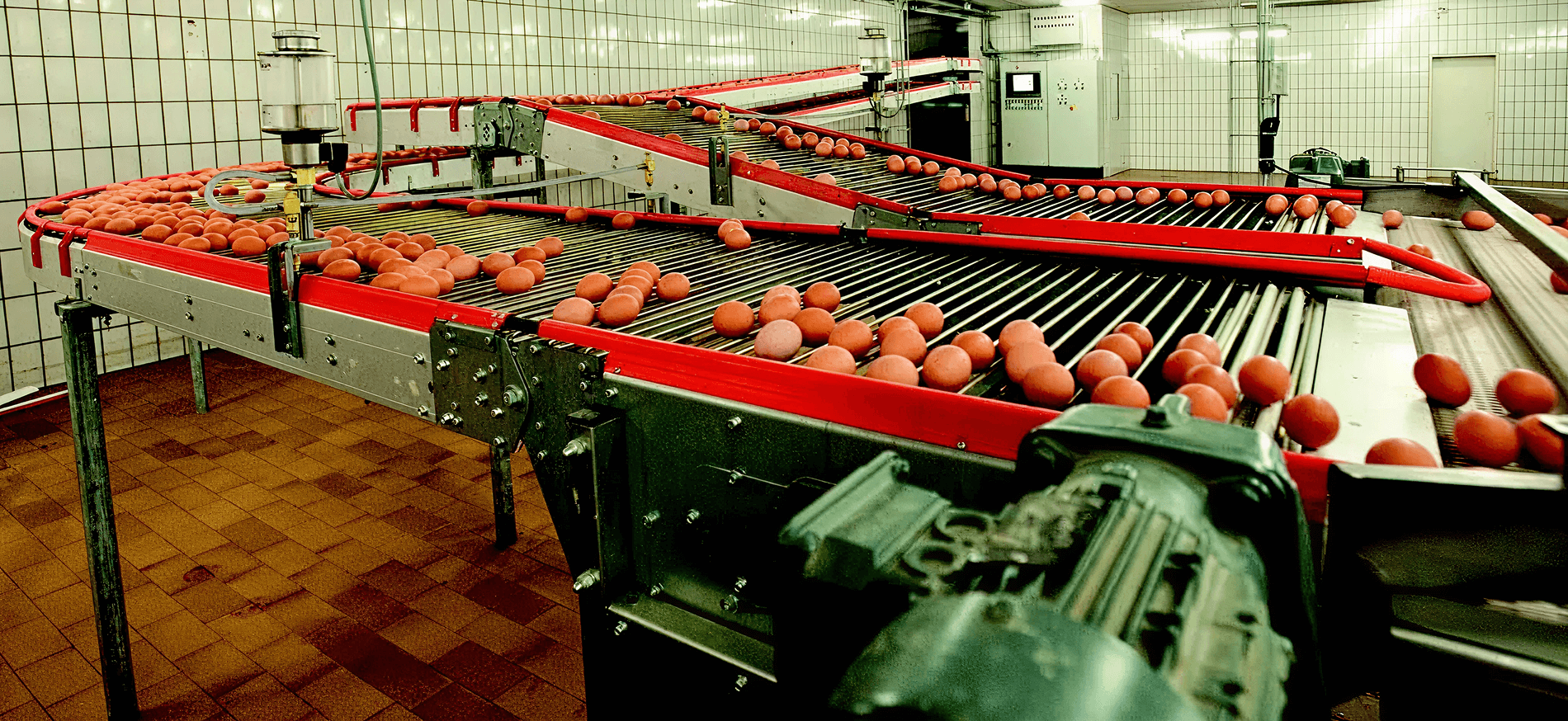
Egg conveyor systems transfer eggs from cage rows or nesting areas to a central collection, grading or packing point. They are primarily used in commercial layer farms and may also be configured for breeder operations, depending on the housing and egg collection system.
Automating egg movement reduces the need for workers to repeatedly carry eggs along poultry house rows. It also creates a more structured collection process for farms handling larger daily egg volumes.
LUBING Egg Conveyor System
TSIS supplies LUBING egg conveyor systems that can be customised according to the poultry house length, cage arrangement, collection point and required handling capacity.
The system can be configured with different chain widths, curves, drive units and routing options to accommodate changes in distance, direction and elevation.
| Specification | Available Options |
|---|---|
| Conveyor chain widths | 200 mm to 750 mm |
| Handling capacity | 15,000 to 65,000 eggs per hour, depending on configuration |
| Routing | Can accommodate different distances, curves and height changes |
| Typical applications | Commercial layer farms and selected breeder operations |
| Additional components | Guide units, drive units, bends and chain lubrication equipment |
A LUBING electric drip-oiler can be incorporated to support continuous conveyor chain lubrication. An optional cleaning unit is also available for conveyor chain hygiene management.
The cleaning unit uses ultrasound, hot water and a cleaning agent to remove dirt and contamination from the conveyor chain. It may be integrated into a new conveyor line or retrofitted to an existing compatible system, with stationary and mobile configurations available.
3. Manure Conveyor and Belt Systems
Manure removal is particularly important in intensive layer operations where waste accumulates beneath multiple cage tiers. If manure remains inside the poultry house for extended periods, it can create additional cleaning, odour and environmental management challenges.
A manure conveyor or belt system collects waste beneath the cage rows and transports it towards a designated removal point. This reduces the need for workers to clean manually beneath each cage tier.
Manure Belt Battery System
In the TSIS Manure Belt Battery (MBB) cage system, manure belts are installed beneath each cage tier to collect and remove waste from the poultry house.
The system supports:
- Regular removal of manure from beneath cage rows
- Reduced manual cleaning requirements
- Separation between the birds and accumulated manure
- More organised waste handling
- Better poultry house hygiene management
For enclosed layer houses, manure removal should work together with appropriate ventilation and environmental control. The final system configuration depends on the cage arrangement, poultry house dimensions, waste removal route and farm management requirements.
Industrial Conveyor Systems vs Manual Poultry Handling
Manual handling may remain practical for smaller poultry operations with shorter transport distances and lower daily material volumes. As farm capacity and the number of poultry houses increase, conveyor automation can reduce repetitive movement and create a more structured operating process.
| Operating Factor | Manual Poultry Handling | Industrial Conveyor Automation |
|---|---|---|
| Material movement | Workers carry or move feed, eggs and waste between locations | Materials are transferred through designated conveyor routes |
| Labour requirement | Requires more direct involvement in repetitive transport tasks | Reduces repetitive manual movement |
| Workflow consistency | Depends more heavily on worker availability and handling methods | Provides a more controlled transfer process |
| Farm expansion | Becomes more difficult to manage as transport distances and capacity increase | Can be configured to support larger or multi-house operations |
| Worker responsibilities | More time is spent carrying, collecting or removing materials | More time can be allocated to monitoring, inspection and maintenance |
Conveyor automation does not eliminate the need for farm workers. Workers are still required to monitor the system, inspect equipment, perform routine maintenance and manage overall poultry operations. The purpose of automation is to reduce repetitive physical handling and use available labour more efficiently.
Conveyor Applications by Poultry Farm Type
The right conveyor system depends on the type of poultry operation and the processes that need to be automated. Layer, breeder and broiler farms have different production priorities and therefore require different conveyor configurations.
| Poultry Operation | Main Material-Handling Requirements | Common Conveyor Applications |
|---|---|---|
| Layer farms | Feed delivery, egg collection and manure removal | Feed conveyor systems, egg conveyors and manure belt systems |
| Breeder farms | Feed delivery and egg handling, depending on the housing and nesting system | Feed conveyor systems and selected egg transfer solutions |
| Broiler farms | Feed transport across poultry houses | Feed conveyor and automatic feeding systems |
Layer Farms
Commercial layer farms usually require the highest level of conveyor integration because feeding, egg collection and manure removal are all part of daily production. Combining these systems can create a more organised workflow from feed delivery to egg collection and waste management.
Breeder Farms
Breeder operations require careful planning around feeding and egg handling. The appropriate conveyor system depends on the housing arrangement, nesting system, collection point and production requirements.
Broiler Farms
Broiler farms primarily use conveyor automation to support feed transport and distribution. The required configuration depends on factors such as flock capacity, house length, silo location and the arrangement of feeding lines.
The final conveyor solution should be selected according to the farm layout, production process, existing equipment and planned level of automation rather than farm type alone.
How to Choose the Right Industrial Conveyor System for Your Poultry Farm
Selecting a poultry conveyor system involves more than comparing equipment capacity. The system must suit the material being transported, farm layout, production requirements, existing equipment and future expansion plans.
Key Selection Factors
| Selection Factor | What to Consider |
|---|---|
| Poultry operation | Whether the farm produces table eggs, breeder eggs or broiler chickens |
| Material handled | Feed, eggs and manure require different conveyor designs |
| Required capacity | The volume of feed, number of eggs or amount of waste handled within a given period |
| Farm layout | Poultry house dimensions, cage arrangement and location of collection or removal points |
| Transport route | Distance, curves, changes in direction and differences in elevation |
| Existing equipment | Compatibility with cage systems, feeding lines, nesting systems and other farm equipment |
| Operating environment | Exposure to moisture, dust, heat and routine cleaning |
| Maintenance access | Ease of inspection, cleaning, lubrication and replacement of worn components |
| Future expansion | Whether additional poultry houses, cage rows or production capacity may be added later |
The appropriate system should be configured according to the farm’s actual operating conditions. A solution designed for one poultry house may not provide the required routing, capacity or integration for a larger multi-house operation.
For a more detailed selection process, read our guide on how to choose the right conveyor system for your poultry farm.
Information Required for a Conveyor Recommendation
Providing accurate farm information helps the equipment supplier assess the required system type and configuration.
Before requesting a recommendation or quotation, prepare the following information:
- Type of poultry operation
- Farm location
- Planned bird capacity
- Number and dimensions of poultry houses
- Existing cage, nesting or feeding systems
- Material that needs to be transported
- Required handling capacity
- Approximate transport distance
- Changes in direction or elevation
- Current collection or removal point
- Planned farm expansion
Drawings, floor plans or photographs of the existing farm layout may also help clarify routing and equipment integration requirements.
Equipment Integration and Supplier Support
Poultry conveyor systems often operate as part of a wider farm automation setup. Feed conveyors may connect storage silos to feeding lines, egg conveyors may integrate with cage or nesting systems, and manure belts must correspond with the cage arrangement and waste removal route.
Before selecting a supplier, consider whether the company can provide guidance on:
- System configuration
- Compatibility with existing equipment
- Installation requirements
- Operating and maintenance procedures
- Replacement components
- Future system expansion
Evaluating these areas before installation can help reduce equipment compatibility issues and unnecessary modifications later.
Why Choose TSIS for Poultry Conveyor Systems?
Tong Seh Industries Supply Sdn Bhd (TSIS) has been involved in the poultry equipment industry since 1981. The company supplies equipment for layer, broiler and breeder operations in Malaysia and international markets.
TSIS provides poultry conveyor and automation solutions covering feed transport, egg collection and manure removal. Rather than treating each conveyor as a standalone component, the system configuration can be planned according to the wider farm layout and existing poultry equipment.
Key areas considered during system planning include:
- Type of poultry operation
- Target production capacity
- Poultry house dimensions and cage arrangement
- Required transport capacity and distance
- Connection with feeding, nesting or collection systems
- Changes in direction or elevation
- Existing farm equipment
- Future expansion requirements
As a Malaysian poultry equipment supplier, TSIS works with farm operators to identify suitable equipment configurations based on their operational requirements.
Discuss Your Poultry Conveyor Requirements
Industrial conveyor systems are an important part of modern poultry farm automation. Whether used for feed delivery, egg collection, or manure management, the right conveyor solution can help farms improve workflow consistency and reduce dependence on repetitive manual handling.
For poultry farms planning automation upgrades, selecting the right system starts with understanding the farm layout, production requirements, and long-term operational goals.
Tong Seh Industries Supply Sdn Bhd provides customised poultry automation solutions, including conveyor systems, feeding systems, and layer cage solutions for commercial farms.
Contact TSIS to discuss your poultry automation requirements and find a suitable conveyor solution for your farm.
FAQ About Poultry Conveyor Systems
What is an industrial conveyor system for poultry farms?
An industrial conveyor system for poultry farms is a mechanical handling solution used to transport feed, eggs or manure with less manual movement. The system may connect storage silos, feeding lines, cage rows, nesting areas, collection points or waste removal areas.
What types of conveyor systems are used in poultry farms?
The main types are feed conveyor systems, egg conveyor systems and manure conveyor or belt systems. The appropriate system depends on the poultry operation, material being transported, farm layout and required handling capacity.
Which poultry farms can use conveyor systems?
Layer, broiler and breeder farms can use conveyor systems for different purposes. Layer farms commonly use feed, egg and manure conveyors, while broiler farms mainly use feed transport systems. Breeder farm requirements depend on the housing, feeding and nesting arrangements.
Can a poultry conveyor system be integrated with existing equipment?
Integration may be possible depending on the existing cage system, feeding lines, nesting equipment, poultry house layout and available space. The current equipment and farm layout should be assessed before a suitable configuration is recommended.
How do I choose the right poultry conveyor system?
Consider the material being transported, required capacity, transport distance, poultry house dimensions, changes in direction or elevation, existing equipment and future expansion plans. The system should be configured according to the farm’s actual operating requirements.
What maintenance does a poultry conveyor system require?
Maintenance requirements vary according to the conveyor type and configuration. Common tasks include regular inspection, cleaning, lubrication where required, checking drive components and replacing worn parts. Operators should follow the maintenance guidance provided for the selected equipment.
Are poultry conveyor systems suitable for farms in Malaysia?
Poultry conveyor systems can be configured for commercial farms in Malaysia. When selecting equipment, farm operators should consider local conditions such as heat, humidity, dust, cleaning requirements and the poultry house environment.
What information should I provide when requesting a conveyor recommendation?
Provide the farm location, poultry type, target bird capacity, number and dimensions of poultry houses, existing equipment, material being transported, required capacity and approximate transport route. Layout drawings or photographs can also help with the initial assessment.
Conclusion: Selecting the Right Poultry Conveyor Solution
Industrial conveyor systems help commercial poultry farms create a more organised process for feed transport, egg collection and manure removal. The appropriate solution depends on the poultry operation, farm layout, required handling capacity, existing equipment and future expansion plans.
Feed conveyors, egg conveyor systems and manure belts serve different functions and should be configured according to the material being handled and the wider poultry production setup. Proper system planning also helps ensure that conveyor equipment can work together with cage, feeding, nesting and environmental control systems.
Tong Seh Industries Supply Sdn Bhd provides poultry conveyor and automation solutions for commercial farm operations. Contact our team to discuss your farm layout, production requirements and suitable conveyor configuration.
Related Poultry Conveyor Guides
Disclaimer:
The information provided in this article is for general informational purposes only. Readers are encouraged to consult with a qualified professional or contact Tong Seh for advice and solutions tailored to their specific needs. While we strive to provide accurate and up-to-date information, we cannot guarantee that it is entirely error-free. Tong Seh Industries Supply Sdn Bhd (TSIS) assumes no responsibility for any errors or omissions.