Choosing a Conveyor System for Your Poultry Farm
Choosing the right poultry conveyor system starts with understanding what the farm needs to transport and how the equipment will fit into the existing production process. Feed, eggs and manure have different handling requirements, so each application requires a different conveyor design.
The appropriate system also depends on the farm type, poultry house layout, required handling capacity, existing equipment and future expansion plans. A system that does not match these requirements may create routing, capacity, maintenance or equipment integration issues after installation.
This guide explains the steps involved in selecting a poultry conveyor system, from identifying the process to be automated to comparing system types and assessing the farm layout.
For a complete overview of available feed, egg and manure conveyor solutions, explore our Industrial Conveyor Systems for Poultry Farms in Malaysia.
Step 1: Identify What Your Farm Needs to Automate
Before comparing conveyor models or capacities, identify the material-handling process that currently requires the most time, labour or coordination.
| Farm Requirement | Questions to Consider |
|---|---|
| Poultry operation | Is the farm producing table eggs, breeder eggs or broiler chickens? |
| Process to automate | Does the farm need to transport feed, collect eggs or remove manure? |
| Current handling method | How is the material currently moved, and where are the main difficulties? |
| Required capacity | How much feed, how many eggs or how much waste must be handled within a given period? |
| Number of houses | Will the system serve one poultry house or multiple houses? |
| Existing equipment | Must the conveyor connect with current cages, feeding lines, nesting systems or storage silos? |
| Future plans | Will flock capacity, house numbers or the level of automation increase later? |
Different poultry operations have different priorities. Layer farms may need to automate feeding, egg collection and manure removal, while broiler farms usually focus primarily on feed transport. Breeder farm requirements depend on the housing, feeding and egg collection setup.
Defining the required process first helps narrow the available options and prevents the farm from selecting equipment that does not match its operational needs.
Step 2: Match the Conveyor System to Your Poultry Operation
Different poultry operations have different material-handling priorities. Identifying the farm type helps determine which conveyor systems should be assessed first.
| Poultry Operation | Conveyor Systems to Consider | Main Selection Considerations |
|---|---|---|
| Layer farm | Feed conveyor, egg conveyor and manure belt system | Cage arrangement, egg volume, feed requirements and waste removal route |
| Broiler farm | Feed conveyor or automatic feeding system | Flock capacity, house length, silo location and feeding line arrangement |
| Breeder farm | Feed conveyor and selected egg transfer systems | Housing method, nesting system, feed management and egg collection point |
| Multi-house poultry operation | Centralised feed transport and other systems according to each house | Distance between houses, routing, elevation changes and future expansion |
Commercial layer farms may require all three conveyor types because feeding, egg collection and manure removal form part of the daily production process.
Broiler farms mainly use conveyor automation for feed transport, while breeder farm requirements depend more heavily on the housing, nesting and egg collection setup.
For multi-house operations, the farm must also determine whether material will be transported from a central point or managed separately within each poultry house.
Step 3: Compare the Main Poultry Conveyor Systems
After identifying the farm’s operational priorities, compare the function and selection requirements of the three main conveyor types:
- Feed conveyor systems
- Egg conveyor systems
- Manure removal conveyor or belt systems
Each system handles a different material and must be evaluated according to its required capacity, transport route, connection points and compatibility with existing poultry equipment.
Feed Conveyor System
A feed conveyor system is suitable when a poultry farm needs to transport feed from a storage silo or central feed point to feeding lines within one or more poultry houses.
Before selecting a feed conveyor system, confirm:
- Types of feed being transported
- Required feed volume per hour
- Distance between the storage point and feeding lines
- Number and position of poultry houses
- Changes in direction or elevation
- Silo and feeding line connection points
- Planned future expansion
Our Flex Auger automatic feeding system is available with transport capacities ranging from 400 kg/h to 4,000 kg/h and tube diameters of 55, 75, 90 and 125 mm.
The final model and routing should be selected according to the farm’s feed requirements, conveying distance and layout. Feed conveyor systems may be used in layer, broiler, breeder and multi-house poultry operations.
Egg Conveyor System
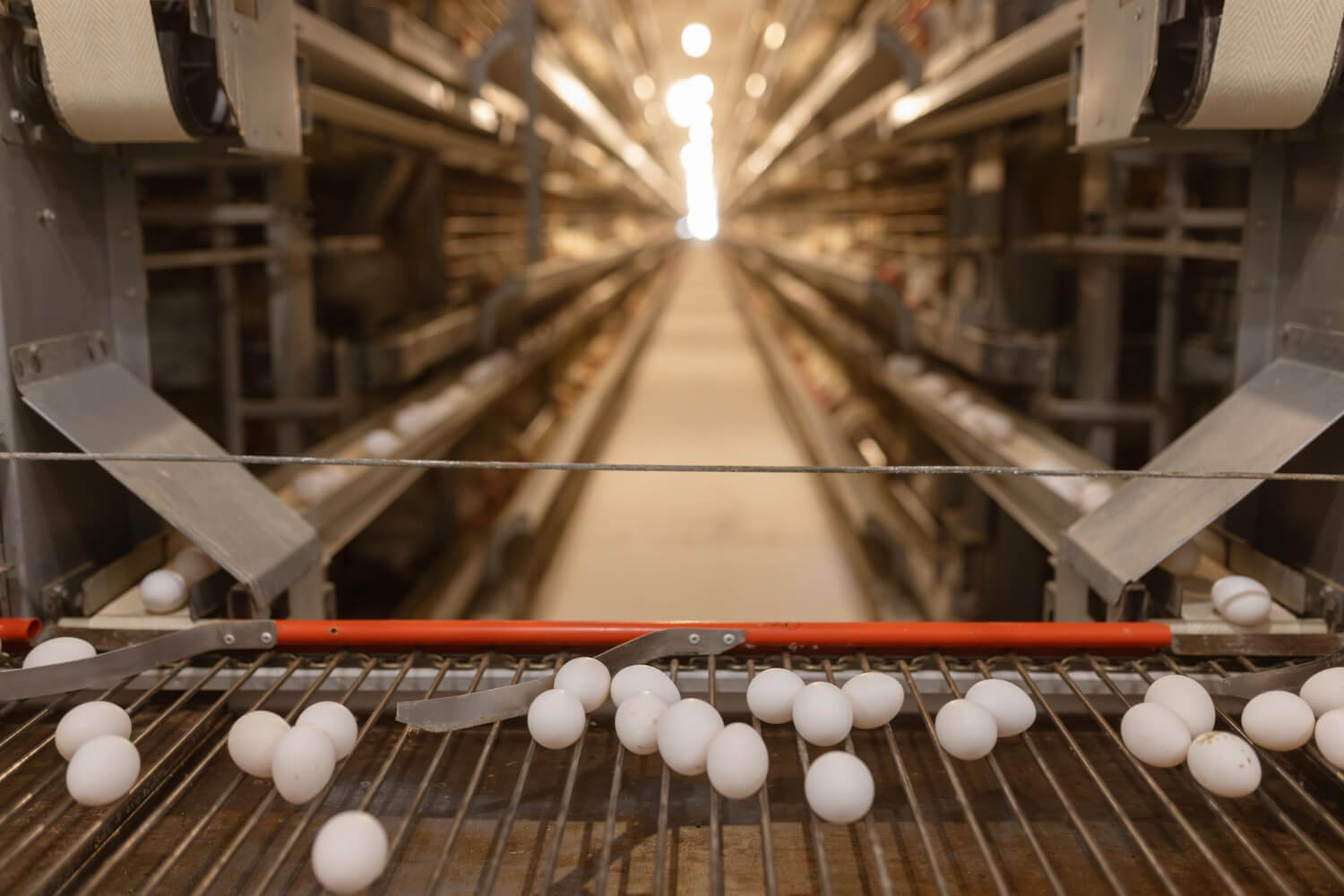
An egg conveyor system is primarily used in commercial layer farms to transfer eggs from cage rows to a central collection, grading or packing point. Selected breeder operations may also require egg transfer systems, depending on the housing and nesting arrangement.
Before selecting an egg conveyor system, confirm:
- Expected egg volume per hour
- Cage or nesting system
- Number and length of cage rows
- Location of the final collection point
- Required curves and changes in elevation
- Available space for drive and transfer components
- Cleaning and maintenance access
We supplies LUBING egg conveyor systems with conveyor chain widths ranging from 200 mm to 750 mm and handling capacities from 15,000 to 65,000 eggs per hour, depending on the system configuration.
Egg conveyor systems are generally not required for broiler farms because broilers are raised for meat production rather than egg production.
Manure Removal Conveyor or Belt System
A manure removal system is used primarily in commercial layer operations where waste must be collected beneath cage tiers and transported towards a designated removal point.
Before selecting a manure removal system, confirm:
- Cage type and tier arrangement
- Poultry house dimensions
- Waste removal direction and discharge point
- Required removal frequency
- Available cleaning and maintenance access
- Compatibility with the existing cage structure
- Ventilation and environmental management requirements
In our MBB (Manure Belt Battery) cage systems incorporates manure belts beneath the cage tiers to collect and remove waste.
Because the manure belts correspond directly with the cage arrangement, the system is generally planned as part of the wider layer cage configuration rather than selected as an independent conveyor.
Poultry Conveyor System Comparison
| Conveyor System | Main Function | Typical Poultry Operations | Key Selection Factors |
|---|---|---|---|
| Feed conveyor | Transports feed from storage to feeding lines | Layer, broiler and breeder farms | Feed volume, feed type, transport distance, routing and silo location |
| Egg conveyor | Transfers eggs to a collection, grading or packing point | Layer farms and selected breeder operations | Egg volume, cage arrangement, row length, collection point and routing |
| Manure conveyor or belt | Collects and removes manure from beneath cage tiers | Commercial layer cage operations | Cage compatibility, house layout, removal route and maintenance access |
The comparison provides an initial guide only. The final system must be assessed according to the farm layout, production capacity, existing equipment and operating requirements.
Step 4: Assess the Farm Layout and Equipment Requirements
Choosing the correct conveyor type is only part of the selection process. The system must also fit the poultry house layout, connect with existing equipment and provide suitable access for operation and maintenance.
Map the Transport Route
Prepare a basic farm layout showing:
- Poultry house dimensions
- Cage or nesting arrangement
- Storage silo or feed starting point
- Feeding line connection points
- Egg collection, grading or packing point
- Manure discharge or removal point
- Distance between poultry houses
- Curves, obstacles and changes in elevation
These details help determine the required conveyor route, drive arrangement and connection points. For multi-house farms, the assessment should also consider whether the system will operate from a central point or separately within each poultry house.
Check Compatibility With Existing Equipment
For new projects, the cage and conveyor systems may be planned together as part of the wider poultry farm layout. For existing farms, the current equipment and available space should be assessed before a new conveyor configuration is recommended.
Relevant layer cage systems may include:
Important compatibility factors include cage row length, number of tiers, available connection points and the location of existing feeding, egg collection or manure removal equipment.
Consider the Operating Environment
Poultry conveyor equipment may be exposed to:
- Heat and humidity
- Dust and feed particles
- Manure and moisture
- Routine washing and cleaning agents
- Regular daily operation
Before selecting a system, confirm that the proposed materials and components are suitable for the expected farm environment and cleaning procedures. The required protection may differ between feed, egg and manure handling applications.
Plan for Inspection and Maintenance Access
Conveyor systems require routine inspection and maintenance. The farm layout should provide reasonable access to:
- Motors and drive components
- Conveyor chains, belts, augers or tubing
- Lubrication points
- Cleaning units
- Transfer and discharge points
- Components that may require adjustment or replacement
Maintenance requirements should be reviewed before installation, particularly where equipment is positioned between cage rows, beneath cage tiers or across elevated routes.
Allow for Future Farm Expansion
Selecting a system only for the farm’s current capacity may limit future expansion. Consider whether the farm may later:
- Increase flock capacity
- Add more cage rows
- Extend existing poultry houses
- Build additional houses
- Add new feeding, egg collection or manure removal equipment
Future plans should be discussed during the initial assessment so that the proposed conveyor configuration can account for possible routing, capacity or equipment changes.
Step 5: Review the Final Conveyor Configuration
Before confirming a poultry conveyor system, review the complete configuration rather than evaluating each component separately.
The final proposal should clearly identify:
| Review Item | Details to Confirm |
|---|---|
| Conveyor purpose | Whether the system will transport feed, eggs or manure |
| Required capacity | The volume of material that must be handled within a given period |
| Transport route | Starting point, final destination, distance, curves and elevation changes |
| Equipment connections | How the conveyor will connect with silos, feeding lines, cages, nests or collection points |
| Operating environment | Expected exposure to heat, humidity, dust, moisture and cleaning procedures |
| Maintenance access | Access to motors, drives, chains, belts, augers, lubrication points and cleaning areas |
| Expansion requirements | Possible increases in flock size, cage rows or poultry house numbers |
The right poultry conveyor system is not necessarily the system with the highest available capacity. It should match the farm’s current operating requirements while allowing for practical maintenance and planned development.
Why Choose Tong Seh Industries for Poultry Conveyor Systems?
Selecting the right supplier is just as important as selecting the right equipment.
At Tong Seh Industries Supply Sdn Bhd, we have been involved in the poultry equipment industry since 1981. We provide customised equipment and automation solutions for commercial layer, broiler and breeder operations.
Our key strengths include:
- More than 40 years of poultry equipment experience
- Poultry conveyor solutions for feed transport, egg collection and manure removal
- System configurations based on farm layout, production capacity and operating requirements
- Integration with poultry cage, feeding and egg collection systems
- Experience serving poultry farms in Malaysia and international markets
For new installations and existing farm upgrades, our team considers the poultry operation, house layout, required capacity, equipment compatibility and future expansion requirements before recommending a conveyor configuration.
Learn more about our industrial conveyor systems for poultry farms in Malaysia.
Discuss Your Poultry Conveyor Requirements
Planning a new poultry farm or upgrading an existing operation? Share your house dimensions, bird capacity, existing equipment and production requirements with our team. We can review the project details and recommend a suitable conveyor configuration based on your operational needs.
Frequently Asked Questions (FAQs)
How do I choose the right conveyor system for my poultry farm?
Planning a new poultry farm or upgrading an existing operation? Share your house dimensions, bird capacity, existing equipment and production requirements with our team. We can review the project details and recommend a suitable conveyor configuration based on your operational needs.
Which conveyor systems are commonly used on layer farms?
Commercial layer farms may use feed conveyors, egg conveyor systems and manure belt systems. The appropriate combination depends on the cage arrangement, production capacity, egg collection process and waste removal requirements.
What determines the required conveyor capacity?
Capacity depends on the material being handled and the farm’s operating requirements. Important factors include flock size, feed consumption, expected egg volume, number of poultry houses and the time available to complete each transport process.
Can a poultry conveyor system be customised according to the farm layout?
Yes. Poultry conveyor systems can be configured according to house dimensions, cage arrangement, transport distance, curves, elevation changes and connection points. The available configuration depends on the selected equipment and site requirements.
Can a conveyor system be added to an existing poultry farm?
It may be possible to add a conveyor system to an existing farm. The current cage system, feeding or nesting equipment, available space, transport route and structural layout should be assessed before a suitable configuration is recommended.
What information should I prepare before requesting a conveyor recommendation?
Prepare the farm location, poultry type, target bird capacity, number and dimensions of poultry houses, existing equipment, material being transported, required capacity and approximate transport route. Layout drawings or photographs may also help with the assessment.
Can Tong Seh help recommend a suitable poultry conveyor system?
Yes. We can review the poultry operation, farm layout, production capacity and existing equipment before recommending a conveyor configuration based on the project requirements.
Disclaimer:
The information provided in this article is for general informational purposes only. Readers are encouraged to consult with a qualified professional or contact Tong Seh for advice and solutions tailored to their specific needs. While we strive to provide accurate and up-to-date information, we cannot guarantee that it is entirely error-free. Tong Seh Industries Supply Sdn Bhd (TSIS) assumes no responsibility for any errors or omissions.