Feed management is one of the most important cost factors in poultry farming. In most layer and breeder operations, feed represents the largest portion of operational expenses. The method used to distribute feed therefore directly affects efficiency, labour cost, bird performance and long-term profitability.
Many poultry farms in Malaysia still use manual feeding. However, increasing labour costs and farm expansion are leading more operators to consider installing an automatic feeding system.
This guide explains the practical differences between manual and automatic feeding systems so you can make a well-informed decision for your farm.
What Is a Manual Feeding System?
A manual feeding system relies on workers to distribute feed into troughs or feeders using buckets, trolleys or simple carts. This method is commonly found in small-scale or traditional poultry farms.
Advantages of Manual Feeding
- Lower initial capital investment
- Simple operation
- Minimal mechanical components
- Suitable for small flocks
Limitations of Manual Feeding
- High labour requirement
Workers must distribute feed multiple times per day. As flock size increases, additional labour is needed. - Inconsistent feed distribution
Uneven feed quantity along the feeding line can result in unequal bird growth and increased competition. - Higher feed wastage
Spillage during transport and uneven filling of feeders may increase feed loss. - Increased biosecurity risk
Frequent human movement inside poultry houses increases the risk of contamination.
Manual feeding can be manageable for small operations, but efficiency decreases significantly as production scales up.
What Is an Automatic Feeding System?
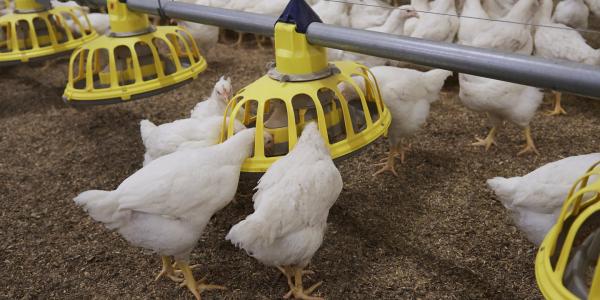
An automatic feeding system uses mechanical components to transport feed from storage silos directly to feeding lines in a controlled and enclosed manner.
A common solution used in layer farms is a Flex Auger feeding system. It typically consists of:
- A motor drive unit
- A spiral auger inside durable tubing
- Feed hoppers or feeding lines
- Control mechanisms for regulated feeding
When the motor operates, the spiral auger rotates and moves feed through the enclosed tube. This ensures steady and uniform feed delivery along the entire feeding line.
Manual vs Automatic Feeding System: Technical Comparison
Labour Requirement
Manual feeding requires direct worker involvement at every feeding cycle.
An automatic feeding system significantly reduces daily labour demand. Workers are still required for monitoring and maintenance, but not for physically distributing feed.
For medium and large farms, this reduction in labour dependency improves operational stability.
Understanding these differences helps you decide which system aligns with your production goals, farm size, and automation needs.
Also Read: 6 Ways to Reduce Labour in Layer Farms
Feed Consistency
Consistent feed access is important for uniform bird growth.
Manual systems may result in:
- Overfeeding in certain areas
- Underfeeding in others
- Delays in feed availability
An automatic feeding system delivers feed more evenly across the feeding line, helping maintain more consistent flock performance.
Feed Wastage Control
Manual feeding increases the risk of:
- Spillage during transport
- Uneven filling
- Exposure to moisture
An enclosed poultry feed automation system reduces exposure and allows controlled feed movement, helping to minimise unnecessary losses.
Biosecurity and Hygiene
In manual systems:
- Workers frequently enter poultry houses
- Feed is exposed during distribution
In automatic systems:
- Feed travels inside enclosed tubing
- Human contact with feed is reduced
- House disturbance is minimised
This supports better hygiene management, especially in intensive layer operations.
Scalability and Expansion
Manual feeding becomes increasingly difficult to manage as flock size grows.
An automatic feeding system is more suitable for:
- Long feeding lines
- Multi-tier cage systems
- Multi-house farms
- Future farm expansion
For farms planning growth, automation provides a more structured foundation.
Cost Consideration: Initial Investment vs Long-Term Efficiency
Initial Cost
Manual feeding requires minimal equipment investment.
An automatic feeding system involves investment in:
- Drive motors
- Auger mechanisms
- Tubing and control components
The upfront cost is higher compared to manual systems.
Long-Term Operational Impact
Over time, automatic systems may help reduce:
- Labour expenses
- Feed wastage
- Inconsistent feeding issues
For medium and large commercial farms, long-term efficiency gains can justify the initial installation cost.
Each farm should evaluate:
- Current labour expenditure
- Feed consumption volume
- Planned expansion
- Production targets
Maintenance and Reliability
Buyers often ask whether automatic feeding systems are complicated.
In reality, systems such as Flex Auger designs are mechanically straightforward. Maintenance typically involves:
- Regular inspection
- Monitoring motor condition
- Checking for feed blockage
- Routine cleaning
When properly installed and maintained, automatic feeding systems are designed for continuous operation in poultry houses.
When Should You Upgrade?
You may consider installing an automatic feeding system if:
- Flock size is increasing
- Labour costs are rising
- Feed wastage is affecting margins
- You are upgrading to automatic layer cage systems
- You want more consistent feeding schedules
For poultry farms operating in Malaysia’s high humidity and warm climate, enclosed feed transport systems can support more stable operations.
Which Feeding System Is Right for Your Farm?
Manual feeding may be suitable if:
- Your farm is small
- Labour is readily available
- Expansion is not planned
An automatic feeding system is generally more appropriate if:
- You operate a commercial layer or breeder farm
- You manage large flocks
- You plan long-term expansion
- You want improved efficiency and feed control
The right choice depends on your production goals, budget, labour situation and future strategy.
Improve Your Poultry Feeding Efficiency
Upgrading to a reliable automatic feeding system helps reduce labour dependency, improve feed consistency and support long-term farm expansion.
Whether you are operating a layer or breeder farm, choosing the right system is key to maintaining productivity and feed control.
Conclusion
Manual feeding offers simplicity and low initial cost. However, as farms grow and labour becomes more expensive, efficiency and consistency become more important.
An automatic feeding system provides structured feed distribution, reduced labour dependency, improved feed control and better scalability for expanding poultry farms.
If you are considering feed automation for your operation, explore the Flex Auger automatic feeding system
Frequently Asked Questions (FAQs)
What is the main difference between manual and automatic feeding systems in poultry farms?
The main difference is how feed is distributed. A manual feeding system relies on workers to physically distribute feed, while an automatic feeding system uses mechanical components such as augers and motors to transport feed directly from the silo to feeding lines. Automatic systems provide more consistent feed delivery and reduce labour dependency.
Does installing an automatic feeding system eliminate the need for workers?
No. Workers are still required for monitoring, maintenance and overall farm management. However, the system significantly reduces manual labour required for daily feed distribution.
How do I choose between manual and automatic feeding for my poultry farm?
The decision should consider flock size, labour availability, feed consumption volume, production goals and expansion plans. Medium to large commercial farms generally benefit more from an automatic feeding system, while very small operations may still manage with manual feeding.
Disclaimer:
The information provided in this article is for general informational purposes only. Readers are encouraged to consult with a qualified professional or contact Tong Seh for advice and solutions tailored to their specific needs. While we strive to provide accurate and up-to-date information, we cannot guarantee that it is entirely error-free. Tong Seh Industries Supply Sdn Bhd (TSIS) assumes no responsibility for any errors or omissions.