
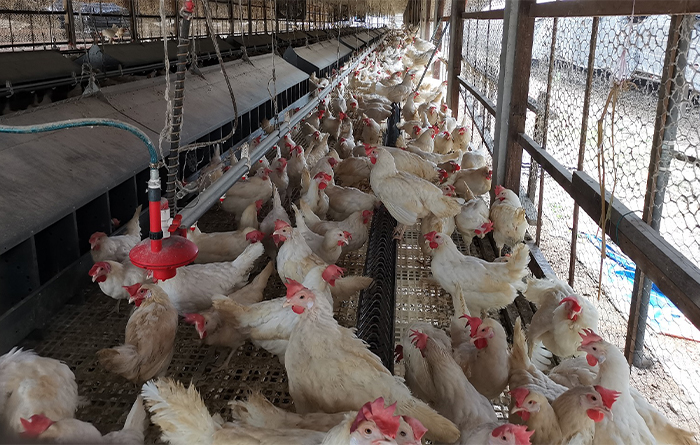
The Philippine poultry industry entered 2026 with continued growth in poultry and egg production. For commercial farm operators, that growth brings opportunity, but it also adds pressure. Larger flocks mean more feed to distribute, more eggs to handle, more manure to remove and tighter control over conditions inside each poultry house.
This is where automation can make a practical difference. The purpose is not simply to replace manual work with machines. A well-planned poultry farm automation system helps make daily tasks more consistent, gives farm managers better control over production and allows the operation to grow without increasing labour demands at the same rate.
This article looks at the latest Philippine poultry production data, the operational pressures behind automation investment and the systems that layer, broiler and breeder farms should assess before upgrading. Farms already planning a project can also explore Tong Seh’s complete range of poultry equipment for commercial farms in the Philippines, including cage, feeding, drinking, egg collection, manure removal and climate control systems.
How Is the Philippine Poultry Industry Performing in 2026?
Official data shows that the industry continued to expand through the first half of 2026.
The Philippine Statistics Authority (PSA) reported that:
- Annual poultry production reached 3.21 million metric tonnes in 2025, up 9.1% from 2024. Chicken represented 71.2% of total poultry production, while chicken production increased by 9.8%.
- According to the Q1 2026 Livestock and Poultry Quarterly Bulletin, chicken production reached 585.47 thousand metric tonnes (liveweight), up 5.8% year on year. Chicken egg production reached 222.95 thousand metric tonnes, increasing 10.6% year on year.
- In Q2 2026, total poultry production reached 841.70 thousand metric tonnes, up 6.3% year on year. Chicken egg production increased by 13.2% and was the main contributor to overall growth.
The same Q1 bulletin also recorded 224.96 million chickens as of 31 March 2026, 1.6% more than a year earlier. Layer inventory increased by 12.2%, while broiler inventory rose by 2.4%.
These figures do not mean that every farm is expanding at the same rate. They do, however, show why capacity and workflow planning are becoming more important as national production grows. The Q1 data also shows substantial chicken and laying-flock inventories in regions including CALABARZON, Central Luzon and Northern Mindanao.
Why Are Commercial Poultry Farms Investing in Automation?
Most poultry automation projects are driven by several connected pressures rather than one isolated problem.
Reducing Dependence on Repetitive Manual Work
Feeding birds, collecting eggs and removing manure are repetitive daily tasks. As flock capacity and poultry house length increase, completing them manually requires more time, movement and supervision.
Automated poultry equipment can carry out these processes on a planned schedule. Workers can then spend more time observing flock behaviour, checking equipment, following hygiene procedures and responding to production issues. The benefit is not simply a smaller workforce. It is the ability to use available workers more effectively while keeping routine operations consistent between shifts.
Reducing Dependence on Repetitive Manual Work
Feeding birds, collecting eggs and removing manure are repetitive daily tasks. As flock capacity and poultry house length increase, completing them manually requires more time, movement and supervision.
Automated poultry equipment can carry out these processes on a planned schedule. Workers can then spend more time observing flock behaviour, checking equipment, following hygiene procedures and responding to production issues. The benefit is not simply a smaller workforce. It is the ability to use available workers more effectively while keeping routine operations consistent between shifts.
Improving Feed Delivery Consistency
High input costs remain a long-term concern for poultry producers in the Philippines. The Department of Agriculture’s Philippine Poultry Layer Industry Roadmap identifies high input costs, biosecurity, land use and climate resilience among the industry’s continuing challenges.
An automatic poultry feeding system moves feed from a silo or central storage point to feeding lines throughout the farm. When the system is correctly sized, calibrated and maintained, it can improve feed distribution, reduce unnecessary handling and support a more predictable feeding routine.
It is still important to be realistic about what the equipment can do. Automation cannot correct poor feed quality, an unsuitable ration or incorrect feeder settings. Farm managers must continue to monitor feed intake, flock performance and equipment condition.
Supporting Farm Biosecurity
Avian influenza remains an active disease-management concern, and the Philippine Bureau of Animal Industry continues to publish avian influenza status updates.
Automation can support poultry farm biosecurity by reducing unnecessary movement between houses and limiting repeated manual contact with feed, eggs and manure. Enclosed feed transport, mechanical egg handling and regular manure removal all reduce handling points within the production process.
However, automated equipment is only one part of a biosecurity programme. It must work alongside controlled farm access, cleaning and disinfection, pest control, flock monitoring, staff training and veterinary guidance.
Improving Manure Management and Air Quality
Manure becomes harder to manage as flock density increases. Waste left beneath cage rows for long periods may contribute to ammonia build-up, odour and uncomfortable working conditions.
In a commercial layer house, manure belt systems collect waste beneath each cage tier and move it out of the cage area. More frequent removal can support cleaner conditions and complement the ventilation system in maintaining indoor air quality.
The complete process still needs a suitable belt schedule, routine inspection and an appropriate method for storing, treating or disposing of manure after it leaves the poultry house.
Maintaining Stable Conditions in a Tropical Climate
Poultry houses in the Philippines operate in a hot and humid climate, although conditions vary by region and season. In an enclosed house, temperature, airflow and relative humidity directly affect bird comfort and equipment performance.
Environmental control systems may include exhaust fans, evaporative cooling pads, air inlets, safety curtains, heaters, climate controllers and sensors. The right combination depends on the house dimensions, stocking density, local conditions and type of poultry production.
Automation allows these components to respond more consistently, but good system design remains essential. Simply adding more fans or cooling pads without calculating airflow and house requirements may not produce the expected result.
Which Poultry Farm Processes Can Be Automated?
Commercial farms do not need to automate every task at once. The first priority should usually be the process causing the greatest labour demand, inconsistency, hygiene risk or production bottleneck.
| Farm Constraint | Operational Effect | Automation to Evaluate First |
|---|---|---|
| Uneven or labour-intensive feed delivery | Inconsistent routines and high manual workload | Silo-to-house feed transport and automatic feeding lines |
| Time-consuming egg collection | Repeated movement, slower handling and greater labour demand | Egg collection belts, elevators and conveyor systems |
| Manure accumulating beneath cage rows | More difficult hygiene management and potential ammonia build-up | Manure belt and removal system |
| Unstable heat, humidity or airflow | Greater difficulty maintaining suitable house conditions | Fans, cooling pads, sensors and climate controllers |
| Limited layer-house capacity | Restricted expansion and inefficient use of building space | A suitable multi-tier layer cage system |
Layer Cage and Manure Removal Systems
For commercial egg production, the layer cage system affects bird capacity, feeding access, egg roll-out, manure handling and the daily workflow inside the house.
Tong Seh Industries Supply Sdn Bhd provides MBB, A-Frame and NAF layer cage systems for different farm scales, building designs and levels of automation. The MBB layer cage system combines multi-tier layer housing with automatic feeding and manure belts. A-Frame and NAF systems offer other configurations for farms with different structural and operational requirements.
Farm operators can compare the main differences in our guide to MBB, A-Frame and NAF layer cage systems.
Automatic Feeding Systems
Automatic feeding is relevant to layer, broiler and breeder farms. The system should be chosen according to feed type, required delivery rate, silo position, transport distance, poultry house arrangement and future capacity.
The Flex Auger automatic feeding system can transport pellets, granules, flour and mixed feed while keeping granules intact. Available models range from 400 kg/h to 4,000 kg/h, with tube diameters of 55 mm, 75 mm, 90 mm and 125 mm. This allows the feed transport system to be configured for different farm layouts and delivery requirements.
Automatic Egg Collection Systems
Egg handling becomes increasingly labour-intensive as the number and length of cage rows grow. A poultry egg conveyor moves eggs to a central collection or packing area, reducing repeated movement through the layer house.
Tong Seh supplies LUBING egg conveyor systems that can accommodate different curves, height changes and transfer distances. Available conveyor chain widths range from 200 mm to 750 mm, with capacities from 15,000 to 65,000 eggs per hour, depending on the configuration.
When comparing egg collection equipment, farms should consider peak egg volume, transfer distance, connections between cage rows, cleaning access and compatibility with downstream grading or packing equipment.
Drinking and Environmental Control Systems
Reliable drinking and climate control systems support flock health, bird comfort and production management. Nipple drinking systems provide controlled water delivery when line height, pressure and sanitation are managed correctly.
Environmental equipment helps regulate temperature, airflow and humidity. For a complete poultry house automation project, the drinking, feeding and climate systems should be designed around the same house layout and bird capacity rather than purchased as separate, unrelated components.
Planning an Automation Upgrade for a Philippine Poultry Farm?
The most suitable system depends on your poultry type, target bird capacity, house dimensions and existing equipment. Share these project details with Tong Seh to receive a more relevant equipment recommendation before committing to a layout or specification.
What Should Farms Evaluate Before Investing in Automation?
Buying individual machines without a complete farm plan can create compatibility issues and expensive modifications later. Before requesting a proposal, farm operators should review the following areas.
Production Type and Target Capacity
Layer, broiler and breeder farms have different equipment priorities. Begin by defining the poultry type, current flock size, target capacity and production cycle.
For an expansion, determine whether the new system will serve only the additional house or must connect to existing feed storage, egg collection, climate control or waste-handling infrastructure.
Poultry House Dimensions and Layout
House length, width, clear height, column positions, doorways and service areas all affect cage rows and conveyor routes. Accurate drawings are particularly important for multi-tier cage installations, egg elevators, cross conveyors and feed delivery lines.
Existing farms should also document installed equipment, available access points and any components that will remain in use after the upgrade.
Power, Water and Ventilation Requirements
Automation increases a farm’s reliance on utilities. Confirm the available electrical supply, backup power plan, water quality and pressure, drainage, ventilation design and control locations before finalising the equipment layout.
The project should also define how birds will continue to receive water, ventilation and other essential support during a power interruption or equipment fault.
Maintenance Capability and Spare Parts
Automation does not remove the need for people. Instead, it shifts more of the work from repetitive handling to inspection, cleaning, calibration and preventive maintenance.
Before selecting a system, clarify routine maintenance tasks, wear parts, cleaning access, operator training, technical support and spare-parts planning. A system that the farm team can maintain properly is more valuable than a complex setup that becomes difficult to support.
System Integration and Future Expansion
Cages, feeding lines, drinking lines, egg conveyors, manure removal and environmental controls must work together. The design should account for connection points, operating sequence, controls and maintenance access.
If another poultry house may be added later, discuss the final expansion plan before selecting silo capacity, conveyor routes and control equipment. A phased project should be designed backwards from the farm’s intended capacity. Otherwise, equipment installed in the first phase may restrict later expansion.
Total Investment, Not Equipment Price Alone
The lowest equipment price does not always lead to the lowest operating cost. A realistic comparison should include freight, structural work, utilities, installation, commissioning, staff training, maintenance, spare parts and expected service life.
Potential returns should be assessed using the farm’s own figures, including labour hours, production volume, feed usage, egg handling losses, downtime and expansion plans. This gives the operator a more useful basis for deciding which automation investment should come first.
Is Full Automation Necessary for Every Poultry Farm?
No. The right level of automation depends on farm scale, production targets, labour availability, existing infrastructure and available capital.
A smaller or transitional farm may begin with automatic feeding or selected environmental controls. A growing layer farm may prioritise egg collection before replacing the complete cage system. A new large commercial poultry project may benefit from planning the cage, manure, feeding, drinking, egg collection and climate systems as one integrated installation.
Phased automation can be a practical approach, provided that every stage supports the final farm plan. The key is to avoid solving today’s bottleneck in a way that creates a new layout or capacity problem later.
Philippine Poultry Industry Outlook for 2026 and Beyond
The latest production data points to continued activity across the Philippine poultry sector, with chicken egg production making the largest contribution to poultry growth in Q2 2026. This direction also reflects priorities identified in the Philippine Poultry Layer Industry Roadmap 2022–2040, including investment, innovation, biosecurity and climate resilience.
Automation will not be the right answer to every farm problem. Its strongest value is found where equipment addresses a clear constraint, such as inconsistent feeding, excessive manual egg handling, difficult manure management, poor environmental control or limited room for production expansion.
For farm operators, the more useful question is not simply, “How much can we automate?” It is, “Which part of the operation needs to become more consistent, and what system will still suit the farm five or ten years from now?”
Plan Your Poultry Farm Automation Project
Tong Seh Industries Supply Sdn Bhd was established in 1981 and later expanded into locally designed and manufactured poultry equipment. From Klang, Malaysia, Tong Seh supplies customisable cage, feeding, drinking, egg collection, manure removal and environmental control systems for international poultry projects, including farms in the Philippines.
Planning a new poultry farm, an expansion or an upgrade from manual equipment? Share your farm location, production type, target bird capacity, poultry house dimensions, existing systems and preferred level of automation. The Tong Seh team can assess the project requirements and recommend a suitable configuration.
Frequently Asked Questions (FAQs)
What equipment can be automated on a commercial poultry farm?
Commercial poultry farms can automate feeding, drinking, egg collection, manure removal and climate control. The right system depends on the poultry type, farm capacity, house layout and production requirements.
How much does poultry farm automation cost in the Philippines?
There is no fixed price for poultry automation. Cost depends on poultry type, bird capacity, house dimensions, equipment scope, installation requirements and level of automation. A project assessment is needed before preparing an accurate quotation.
Which poultry farm process should be automated first?
Start with the process creating the biggest operational challenge. Layer farms often prioritise egg collection or manure removal, while broiler farms may focus on feeding and environmental control.
How does an automatic poultry feeding system work?
An automatic feeding system transports feed from a silo or storage point to feeding lines inside the poultry house. System selection depends on feed type, delivery capacity, transport distance and house layout.
How does an automatic egg collection system work?
An automatic egg collection system transfers eggs from cage rows to a central collection or packing area using egg belts, elevators and conveyors. The design depends on cage layout, egg volume and available space.
Can an existing poultry farm be upgraded in phases?
Yes. Existing farms can be upgraded in stages if the current house structure and equipment are compatible. The upgrade plan should consider future capacity, conveyor routes, feeding systems and control integration.
Does automation improve poultry farm biosecurity?
Automation can support biosecurity by reducing unnecessary movement and manual contact with feed, eggs and manure. It should be combined with access control, cleaning, disinfection, pest management and proper farm procedures.
How long does poultry equipment installation take?
Installation time depends on the equipment type, farm size, site conditions and project scope. Proper planning of house layout, utilities and existing systems can help reduce installation challenges.
Disclaimer:
The information provided in this article is for general informational purposes only. Readers are encouraged to consult with a qualified professional or contact Tong Seh for advice and solutions tailored to their specific needs. While we strive to provide accurate and up-to-date information, we cannot guarantee that it is entirely error-free. Tong Seh Industries Supply Sdn Bhd (TSIS) assumes no responsibility for any errors or omissions.