Choosing the Right Layer Cage System for Your Poultry Farm
Selecting the right layer cage system is one of the most important decisions in commercial poultry farming. The system you choose directly affects egg production efficiency, labour requirements, bird health, and long-term operating costs.
A well-designed system helps maintain consistent production, improves hygiene, and supports easier farm management. On the other hand, the wrong system can lead to operational limitations, higher maintenance costs, and reduced productivity over time.
Tong Seh Industries Supply Sdn Bhd (TSIS), a Malaysian poultry equipment manufacturer established in 1981, offers three main layer cage systems:
Each system is designed for different farm sizes, house structures, and levels of automation.
Key Factors Before Choosing a Cage System
Before comparing systems, it is important to understand your farm requirements. The right choice depends on several practical factors:
Farm size and bird capacity
Large commercial farms often require higher automation and scalability, while smaller farms may prioritise simplicity and cost efficiency.
Poultry house design
House type plays a key role. Some farms use fully enclosed, mechanically ventilated houses, while others use open-sided or naturally ventilated structures.
Manure management approach
In tropical climates such as Indonesia, manure control is important for maintaining air quality and bird health. Some systems include built-in manure removal, while others offer flexible configurations.
Labour availability
Automated systems can significantly reduce daily labour needs by handling feeding, egg collection, and manure removal.
Future expansion plans
Some farms require systems that can be expanded or adapted as production increases.
MBB Cage System (Manure Belt Battery)
The MBB (Manure Belt Battery) Cage System is an automatic layer cage system used in commercial poultry farms. It is designed to combine feeding, manure removal, and egg handling in one integrated system to improve farm efficiency.
How the MBB system work
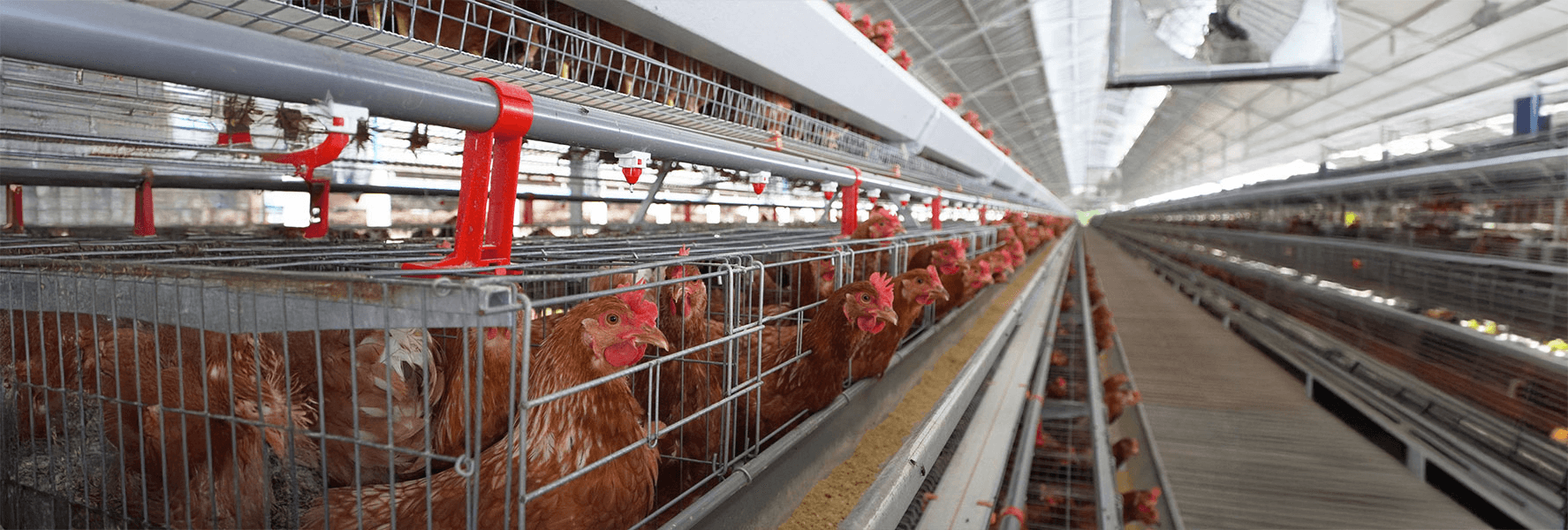
In the MBB system, birds are housed in multi-tier cage rows with a manure belt installed beneath each tier. Manure drops directly onto the belt and is removed regularly from the poultry house, helping maintain a cleaner and more controlled environment.
Feed is delivered through an automated feeding system using feed hoppers with adjustable dosing slides. This ensures uniform feed distribution along the full length of each cage row, supporting consistent flock performance.
The cage floor is designed with reinforced wiring to support bird comfort and to improve egg roll-out efficiency, helping reduce cracked and dirty eggs during collection.
Key features
- Integrated manure belt system for automatic waste removal
- Automated feeding system for consistent feed distribution
- Optimised egg roll-out design to reduce egg damage
- Galvanised steel construction for durability in humid environments
- Available in 3-tier to 6-tier configurations
- Cage rows up to 120 metres in length
- Improved hygiene and reduced ammonia levels
MBB Start and Grow System
TSIS also offers MBB Start/Grow cages for pullets. These systems follow the same structural concept but are adapted for younger birds, with improved ventilation and feeding control to support healthy growth and uniform development.
Best suited for
The MBB system is best suited for large-scale commercial poultry farms that require a high level of automation and stable production performance. It is commonly used in fully enclosed and mechanically ventilated poultry houses where environmental conditions such as temperature and airflow can be controlled.
A-Frame Cage System
The A-Frame cage system is a widely used traditional design known for its practicality and straightforward operation. It is commonly used in medium-scale poultry farms.
How the A-Frame system works
The A-Frame structure consists of back-to-back cage rows forming a slanted “A” shape. Feed is distributed using hopper systems with adjustable dosing slides to ensure consistent feeding across the flock.
Egg roll-out is supported by a sloped cage floor design that directs eggs to the collection area efficiently.
TSIS also provides grower and starter cage options for pullets. The grower cage includes a 1-inch grid floor design to support ventilation and reduce injury risk. The starter cage is designed for early-stage birds with adjustable feeding access and a ¾-inch grid floor.
Key features
- 2-tier to 3-tier configuration
- Cage rows up to 120 metres
- Uniform feed distribution system
- Grower and starter cage options for pullets
- Designed for stable and simple operation
Best suited for
The A-Frame system is suitable for small to medium farms or operations transitioning from manual to automated systems. It is also a practical choice for farms with lower ceiling height or structural limitations.
NAF Cage System
The NAF cage system is a flexible and adaptable solution designed for commercial farms that require scalable layouts and different housing configurations.
How the NAF system works
The NAF system uses similar feeding and egg roll-out principles as other TSIS cage systems, with automated feed distribution and sloped cage flooring to support efficient egg handling.
The main advantage of the NAF system is its flexibility in installation and farm design. It can be configured for different poultry house types and operational setups depending on farm requirements.
Key features
- Available in 3-tier to 6-tier configurations
- Cage rows up to 120 metres
- Flexible installation options based on house design
- Automated feed distribution system
- Designed for scalable commercial production
Start and Grow system
NAF also includes a Start/Grow option for pullets, designed to support early-stage development in a controlled environment.
Best suited for
The NAF system is suitable for farms that require flexibility in house design and future expansion. It is commonly used in commercial farms that operate different housing structures or plan phased development.
Comparison Summary
| Feature | MBB | A-Frame | NAF |
|---|---|---|---|
| Automation level | High | Medium | Medium to High |
| Tier range | 3 to 6 | 2 to 3 | 3 to 6 |
| Manure system | Integrated belt system | Not integrated | Flexible configuration |
| Farm scale | Large commercial farms | Small to medium farms | Medium to large farms |
| House type | Fully enclosed, ventilated | Lower or simpler structures | Flexible house types |
| Key strength | Full automation | Cost efficiency | Flexibility |
Which Cage System Should You Choose?
Each system is designed for a different farm strategy.
Choose MBB if you want full automation, high biosecurity, and maximum operational efficiency for large commercial farms.
Choose A-Frame if you prefer a simpler system for a small to medium farm or are transitioning from manual farming methods.
Choose NAF if you need flexibility in farm design and want a system that can adapt to different housing layouts or expansion plans.
For farms in Indonesia and Southeast Asia, factors such as climate, house design, and labour availability often influence the final decision.
Why Choose TSIS Layer Cage Systems
TSIS has been supplying poultry equipment since 1981, with installations across Asia, Europe, and Africa. All systems are designed for tropical environments and commercial farming conditions.
Key advantages include:
- Over 40 years of manufacturing experience
- Galvanised steel construction for durability
- Designed for tropical climates such as Indonesia and Malaysia
- Modular systems suitable for different farm sizes
- Direct export support from Malaysia
- Technical guidance and after-sales support
Explore Complete Poultry Solutions
TSIS also provides full poultry farm automation systems, including:
- Egg collection systems
- Automatic feeding systems
- Drinking systems
- Environmental control systems
- Manure removal systems
Final Thoughts
Choosing between MBB, A-Frame, and NAF cage systems depends on your farm scale, housing design, and automation goals. Each system offers different advantages, from full automation to flexible installation and cost efficiency.
For commercial poultry farms, selecting the right system early helps ensure long-term productivity and operational stability.
Frequently Asked Questions About Poultry Equipment in Indonesia
What is the difference between MBB, A-Frame, and NAF cage systems?
The main difference is their design, level of automation, and intended farm application.
The MBB (Manure Belt Battery) system includes an integrated manure belt system and is designed for farms seeking a higher level of automation and improved manure management. The A-Frame system uses a traditional cage layout and is commonly chosen for its simplicity and practicality. The NAF system offers a flexible cage design that can be configured for different poultry house layouts and operational requirements.
Which cage system is best for a large commercial poultry farm?
There is no single best cage system for every farm. The most suitable option depends on bird capacity, poultry house design, labour availability, and management preferences.
For large commercial layer farms, MBB and NAF systems are often considered because they are available in higher-tier configurations and can support larger production capacities. Farm operators should evaluate their housing design and automation requirements before selecting a system.
Is an automatic layer cage system worth the investment?
For many commercial poultry farms, an automatic layer cage system can improve operational efficiency by reducing manual work associated with feeding, egg handling, and manure management.
The potential benefits include more consistent daily operations, improved hygiene, and reduced labour requirements. However, the return on investment depends on factors such as farm size, production volume, and management practices.
How do I choose the right chicken cage system for my farm?
The right chicken cage system depends on several factors, including bird capacity, poultry type, house dimensions, ventilation method, labour availability, and future expansion plans.
Providing these details to a poultry equipment supplier allows them to recommend a cage system that matches the farm’s operational requirements and production goals.
Can TSIS cage systems be customised for different farm sizes?
Yes. TSIS layer cage systems can be configured according to farm size, bird capacity, and poultry house layout.
This allows farms to select a system that suits their current production requirements while planning for future expansion when necessary.
Do TSIS cage systems support future farm expansion?
Yes. The MBB, A-Frame, and NAF cage systems are available in different configurations and can be planned according to a farm’s production targets.
When designing a new poultry house, farms can discuss future expansion requirements with the TSIS team to ensure the selected system supports long-term growth.
Does TSIS provide installation guidance and technical support?
Yes. TSIS provides technical guidance and after-sales support for the poultry equipment it supplies.
Farm operators can consult the TSIS team regarding system configuration, installation planning, and equipment operation to help ensure successful implementation.
What information should I provide when requesting a quotation?
To prepare an accurate quotation, TSIS typically requires information such as poultry type, bird capacity, farm location, poultry house dimensions, existing farm setup, and the equipment or automation systems required.
Providing complete project information helps the team recommend a suitable solution and prepare a more accurate proposal.
Need Help Choosing the Right Layer Cage System?
Every poultry farm has different operational requirements. Whether you are planning a new farm, expanding production capacity, or upgrading an existing chicken cage system, the TSIS team can help recommend the most suitable solution based on your farm layout, bird capacity, and production goals.
Disclaimer:
The information provided in this article is for general informational purposes only. Readers are encouraged to consult with a qualified professional or contact Tong Seh for advice and solutions tailored to their specific needs. While we strive to provide accurate and up-to-date information, we cannot guarantee that it is entirely error-free. Tong Seh Industries Supply Sdn Bhd (TSIS) assumes no responsibility for any errors or omissions.