
Labour has become one of the biggest operational challenges in poultry farming today. Rising wages, worker shortages, and increasing demands for efficiency are pushing farm owners to rethink traditional methods.
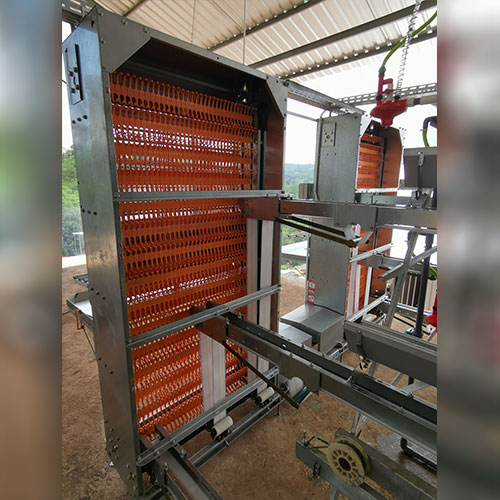
As a result, many poultry farms are turning to automation to stay competitive. One of the most effective solutions is the use of automatic layer cage systems, which streamline daily operations and significantly reduce the need for manual labour.
The Growing Labour Challenge in Poultry Farming
Managing a poultry farm involves repetitive, time-consuming tasks such as feeding, egg collection, cleaning, and monitoring bird conditions. In traditional setups, these tasks require a large workforce and constant supervision.
However, several issues have made labour management more difficult:
- Increasing labour costs
- Difficulty in hiring and retaining workers
- Human errors affecting productivity
- Inconsistent work quality
These challenges not only increase operational costs but also limit a farm’s ability to scale efficiently.
How Automatic Layer Cage Systems Work
Automatic layer cage systems are designed to integrate key farming processes into a single, efficient setup. Instead of relying on manual work, these systems automate essential functions such as:
- Feed distribution
- Water supply
- Egg collection
- Waste removal
By reducing the need for hands-on involvement, farms can operate more efficiently with fewer workers.
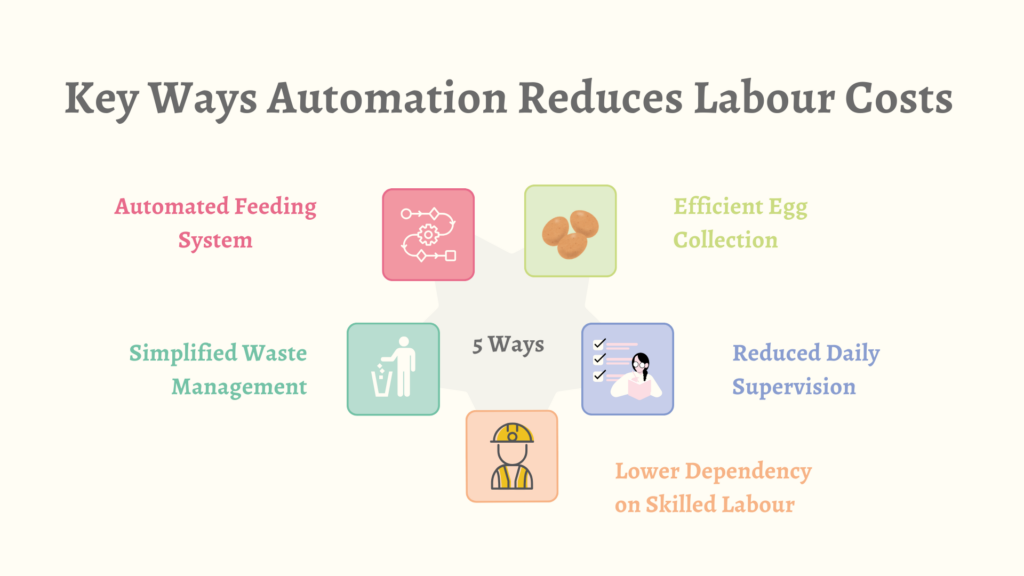
Key Ways Automation Reduces Labour Costs
1. Automated Feeding Systems
Feeding hens manually across large farms is both labour-intensive and time-consuming. Automatic feeding systems distribute feed evenly and at scheduled intervals, eliminating the need for multiple workers.
This ensures consistent nutrition while saving hours of daily labour.
2. Efficient Egg Collection
In traditional systems, workers must collect eggs by hand, which increases the risk of breakage and requires constant effort throughout the day.
Automated egg collection systems gently transport eggs to a central collection point. This reduces the number of workers needed while improving efficiency and product quality.
3. Simplified Waste Management
Cleaning poultry houses is one of the most demanding tasks. Manual waste removal requires significant manpower and can expose workers to unhealthy conditions.
Manure belt systems automatically remove waste from the cages, reducing the need for manual cleaning and improving overall farm hygiene.
4. Reduced Daily Supervision
With automation handling routine tasks, farm operators no longer need to closely supervise every process. This allows fewer workers to manage larger operations effectively.
Farm owners can also focus more on monitoring performance and making strategic decisions rather than handling daily labour tasks.
5. Lower Dependency on Skilled Labour
Training new workers takes time and resources, especially for specialised tasks. Automated systems standardise operations, reducing reliance on skilled labour and minimising human error.
Long-Term Cost Benefits
While the initial investment in an automatic system may seem high, the long-term savings can be substantial. Reduced labour costs, improved efficiency, and lower error rates contribute to better overall profitability.
Farms can also scale operations without needing to proportionally increase their workforce, making growth more sustainable.
Additional Operational Advantages
Beyond labour savings, automation offers several added benefits:
- Improved consistency in daily operations
- Better hygiene and biosecurity
- Reduced physical strain on workers
- More predictable production output
These factors contribute to a more stable and efficient farming environment.
Manual vs Automatic Layer Cage Systems
| Aspect | Manual System | Automatic Layer Cage System |
|---|---|---|
| Labour Requirement | High, requires multiple workers | Low, fewer workers needed |
| Feeding Process | Manual and time-consuming | Automated and consistent |
| Egg Collection | Hand-collected, higher breakage risk | Automated, reduced damage |
| Waste Management | Manual cleaning required | Automated manure removal system |
| Efficiency | Lower, depends on workforce | Higher, consistent daily operations |
| Scalability | Limited by labour availability | Easy to scale with minimal extra labour |
| Operating Cost | Higher long-term labour cost | Lower long-term operational cost |
Is Automation the Right Move for Your Farm?
Automatic layer cage systems are especially beneficial for farms looking to expand or optimise their operations. Whether you are managing a mid-sized farm or planning to scale up, automation can help reduce operational pressure and improve overall efficiency.
Choosing the right system depends on your farm size, production goals, and long-term plans. Working with an experienced supplier can help ensure a smooth transition and reliable performance.
Read Also: 6 Ways to Reduce Labour in Layer Farms
Upgrade Your Poultry Farm with Smarter Automation
Reducing labour costs doesn’t have to mean compromising productivity. With the right automatic layer cage system, you can streamline daily operations, improve efficiency, and scale your farm with confidence.
Whether you’re upgrading an existing setup or planning a new poultry house, choosing a reliable system makes all the difference.
Conclusion
Labour challenges are unlikely to ease anytime soon, making efficiency more important than ever in poultry farming. Automatic layer cage systems provide a practical solution by reducing manual work and streamlining daily operations.
By lowering labour dependency and improving productivity, these systems allow farms to operate more efficiently and remain competitive in a demanding market.
Frequently Asked Questions (FAQs)
How much labour can be reduced with an automatic layer cage system?
An automatic layer cage system can reduce labour requirements by up to 50–70%, depending on farm size and level of automation. Tasks such as feeding, egg collection, and waste removal are handled automatically, allowing fewer workers to manage larger operations.
Is an automatic layer cage system suitable for small poultry farms?
Yes, these systems can be customised for small to medium-sized farms. Even partial automation can help reduce labour costs and improve efficiency without requiring a large-scale investment.
What are the main components of an automatic layer cage system?
The system typically includes automated feeding equipment, nipple drinking lines, egg collection belts, and manure removal systems. These components work together to streamline daily farm operations.
How long does it take to see a return on investment (ROI)?
Most poultry farms can expect to see ROI within 2 to 4 years, depending on factors such as farm size, labour savings, and production efficiency improvements.
Does automation affect egg quality or production?
Yes, in a positive way. Automation helps maintain consistent feeding, reduces handling, and minimises egg breakage, resulting in improved egg quality and more stable production output.
Disclaimer:
The information provided in this article is for general informational purposes only. Readers are encouraged to consult with a qualified professional or contact Tong Seh for advice and solutions tailored to their specific needs. While we strive to provide accurate and up-to-date information, we cannot guarantee that it is entirely error-free. Tong Seh Industries Supply Sdn Bhd (TSIS) assumes no responsibility for any errors or omissions.