
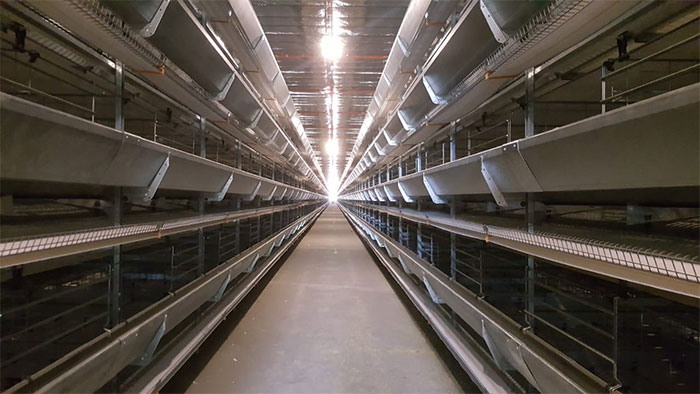
Efficiency plays a critical role in modern poultry farming, especially as farms scale up to meet increasing demand. One of the most important decisions farm operators face is choosing between a traditional cage system and an automatic layer cage system.
While traditional systems have been widely used for decades, advancements in automation have introduced more efficient solutions designed to improve productivity, reduce labour, and enhance farm hygiene. Understanding the differences between these systems is key to making the right investment for long-term success.
What Is a Traditional Cage System?
Traditional cage systems are typically manual or semi-manual setups where most farm operations rely heavily on human labour.
Common characteristics include:
- Manual feeding processes
- Manual egg collection
- Basic or manual cleaning methods
- Higher dependency on workers
While these systems may have lower initial setup costs, they often result in:
- Inconsistent feeding and egg collection
- Increased labour costs over time
- Poorer hygiene control
What Is an Automatic Layer Cage System?
An automatic layer cage system is a modern poultry farming solution designed to automate key processes such as feeding, egg collection, and manure removal.
These systems are built to improve operational efficiency and reduce manual workload. Advanced setups, such as manure belt battery systems, further enhance performance by incorporating automated waste management for better hygiene and environmental control.
Key features include:
- Automated feeding systems
- Automatic egg collection systems
- Efficient manure removal systems
- Integrated design for better farm management
Automatic vs Traditional Cage Systems: Key Efficiency Comparison
| Key Factor | Automatic Layer Cage System | Traditional Cage System |
|---|---|---|
| Labour | Low – automated processes reduce manpower | High – requires daily manual work |
| Egg Production | Consistent and optimized output | Less consistent due to human factors |
| Hygiene | High – regular manure removal (e.g. manure belt systems) | Lower – depends on manual cleaning |
| Operational Efficiency | Streamlined and scalable | Slower and harder to manage |
| Cost Over Time | Lower long-term cost with better ROI | Higher long-term cost due to labour |
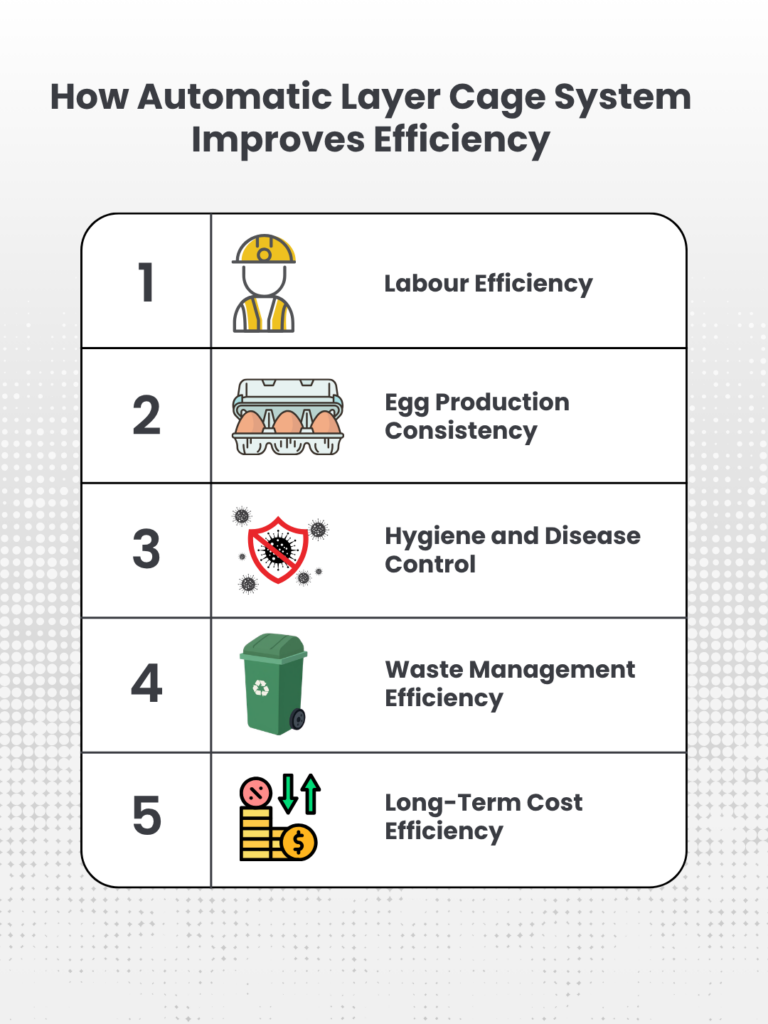
How Automatic Layer Cage System Improves Efficiency
1. Labour Efficiency
Traditional systems require significant manpower for daily operations. Feeding, cleaning, and egg collection must be done manually, which increases labour dependency and operational costs.
In contrast, automatic layer cage systems reduce the need for manual labour by automating repetitive tasks. This allows farm operators to manage larger operations with fewer workers while maintaining consistent performance.
2. Egg Production Consistency
Consistency is essential for profitability. In traditional systems, variations in feeding schedules and human error can affect egg production rates.
Automatic systems ensure:
- Controlled feeding schedules
- Consistent water supply
- Reduced stress on hens
This leads to more stable and predictable egg production over time.
3. Hygiene and Disease Control
Maintaining hygiene is more challenging in traditional cage systems due to manual cleaning and waste accumulation.
Automatic layer cage systems, especially those using manure belt battery systems, provide:
- Regular and efficient waste removal
- Reduced ammonia levels
- Cleaner living conditions for hens
This helps lower the risk of disease and improves overall flock health.
4. Waste Management Efficiency
Waste management is a major concern in poultry farming. Poor handling can lead to environmental issues and health risks.
Traditional systems often rely on manual cleaning, which can be inconsistent and time-consuming.
Automatic systems improve this by:
- Automating manure removal
- Keeping cages cleaner for longer periods
- Supporting better farm sanitation practices
This is where systems like manure belt technology play a significant role in maintaining a cleaner and more sustainable farm environment.
5. Long-Term Cost Efficiency
While traditional cage systems may require lower initial investment, their long-term costs can be higher due to:
- Labour expenses
- Maintenance inefficiencies
- Lower productivity
Automatic layer cage systems involve a higher upfront cost but offer better long-term returns through:
- Reduced labour costs
- Higher productivity
- Improved operational efficiency
Real-World Application: Transitioning to Automation
Many poultry farms transitioning from traditional systems to automatic layer cage systems experience noticeable improvements in efficiency.
Operational changes often include:
- Reduced reliance on manual labour
- Better time management
- Improved hygiene standards
- Increased production consistency
These benefits contribute to a more scalable and sustainable farming operation.
Which System Is More Efficient for Poultry Farms?
For small-scale or budget-limited farms, traditional cage systems may still be a viable option. However, for farms aiming to scale, improve efficiency, and reduce long-term costs, automatic layer cage systems are generally the better choice.
In regions like Malaysia, where labour costs and farm management challenges continue to evolve, automation offers a practical solution for modern poultry operations.
Upgrade Your Poultry Farm with Greater Efficiency
Ready to reduce labour costs and improve egg production consistency? An automatic layer cage system can help you achieve a more efficient and scalable operation.
Contact Tong Seh today to find the right solution for your poultry farm.
Conclusion
Choosing between a traditional cage system and an automatic layer cage system ultimately depends on your farm’s goals, budget, and scale.
However, when it comes to efficiency, productivity, and long-term sustainability, automatic layer cage systems clearly offer significant advantages. With features such as automated feeding, egg collection, and advanced waste management solutions like manure belt battery systems, they provide a smarter and more reliable approach to poultry farming.
Frequently Asked Questions (FAQs)
What is an automatic layer cage system?
An automatic layer cage system is a modern poultry farming setup that automates key processes such as feeding, egg collection, and manure removal. It helps improve efficiency, reduce labour, and maintain better hygiene compared to traditional systems.
How is an automatic layer cage system more efficient than traditional cage systems?
Automatic systems reduce manual labour, ensure consistent feeding schedules, improve egg collection efficiency, and maintain cleaner environments through automated manure management, resulting in higher overall productivity.
What is a manure belt battery system in poultry farming?
A manure belt battery system is a type of automatic layer cage system that uses conveyor belts to remove waste regularly. This helps improve farm hygiene, reduce ammonia levels, and support better flock health.
Is an automatic layer cage system suitable for small poultry farms?
Yes, automatic layer cage systems can be adapted for different farm sizes. While the initial investment is higher, small farms can benefit from improved efficiency and reduced labour costs over time.
How much does it cost to install an automatic layer cage system in Malaysia?
The cost varies depending on farm size, system design, and level of automation. While the upfront investment may be higher than traditional systems, the long-term savings in labour and increased productivity often provide a strong return on investment.
Disclaimer:
The information provided in this article is for general informational purposes only. Readers are encouraged to consult with a qualified professional or contact Tong Seh for advice and solutions tailored to their specific needs. While we strive to provide accurate and up-to-date information, we cannot guarantee that it is entirely error-free. Tong Seh Industries Supply Sdn Bhd (TSIS) assumes no responsibility for any errors or omissions.