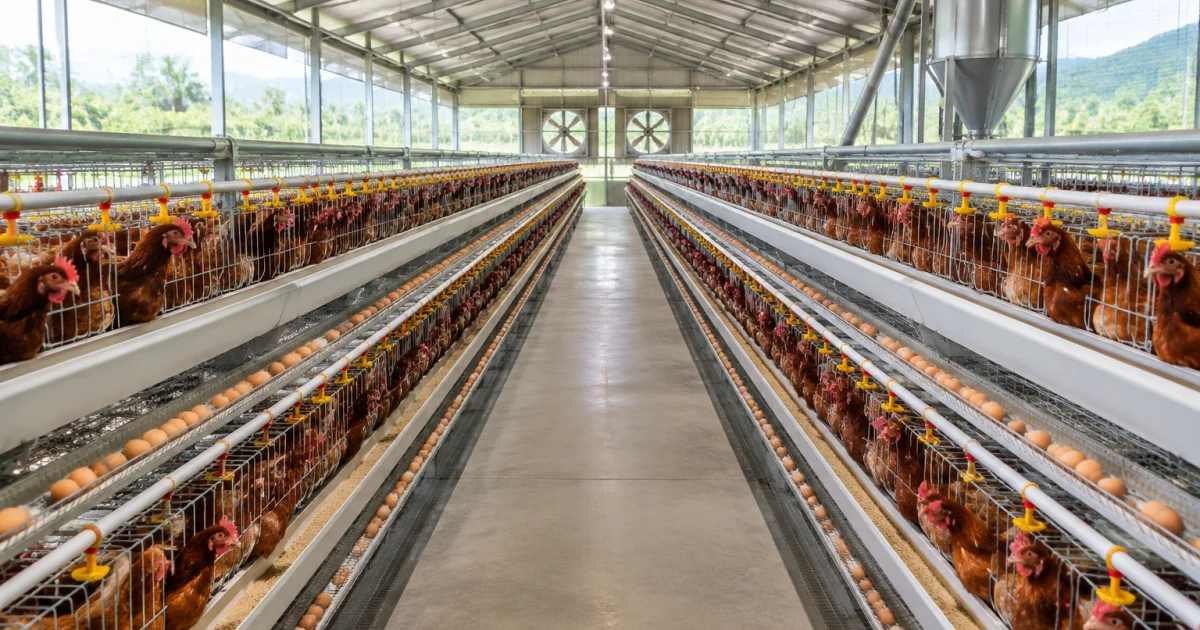
For high-density layer operations, housing is not just a welfare discussion—it’s a long-term investment that shapes labour, egg flow, biosecurity, and environmental control. In Malaysia, where land efficiency and consistent output matter, the chicken cage system is still the default for many upgrades and new builds.
My view: cages are often the best choice for high-density layer farms—but only when treated as a complete production system (housing + feeding + drinking + egg handling + ventilation + manure management). If cages are installed without the right supporting poultry farming equipment and a realistic maintenance plan, the advantages shrink fast.
Below is a practical operator’s view of where cages perform best, what they demand, and how to decide whether to invest in cages now—or fix bottlenecks first.
What “best choice” means for high-density farms (and what it doesn’t)
When farm owners ask if cages are the best option, they usually want to:
- Maximise birds per footprint while keeping management controllable.
- Stabilise egg collection and grading with less handling and lower breakage.
- Reduce labour dependence through automation and repeatable routines.
- Improve biosecurity and health consistency versus open floor systems.
But “best” does not mean pushing density beyond what your site can support. Real limits typically come from:
- Ventilation capacity (heat removal, humidity control, air distribution).
- Water reliability (pressure/flow stability, hygiene, backups).
- Feed logistics (silo sizing, auger routing, power stability, uniform distribution).
- Manure management (removal frequency, drying, odour/ammonia control).
The decision is less “cages vs no cages” and more: Can your farm run dense stocking with predictable performance and manageable risk?
Where cage systems still outperform alternatives for high-density layer production
Even as welfare expectations evolve, cages remain popular in high-density commercial production because they reduce variability and simplify daily work.
1) Controlled egg flow: conveyors, collection, and breakage reduction
At scale, performance depends on moving eggs reliably. With roll-out cages and integrated egg belts, farms can standardise collection timing and reduce manual handling that causes cracks, dirty eggs, and missed collection windows. Well-planned transfer points and an egg conveyor layout also make it easier to increase throughput without adding as much labour.
2) Labour predictability through automation
Cages fit naturally with an automatic feeding system, automated drinking lines, and centralised egg collection. The win is not only fewer people—it’s repeatable routines and easier supervision. The caution: automation must be correctly sized and commissioned for house length, tiers, and demand. Undersized motors, poor auger routing, or unstable water pressure can turn “automation” into daily troubleshooting.
3) Biosecurity and monitoring at scale
Cage layouts can improve separation between birds and manure, create clearer walkways, and make checks more systematic (feed, water, egg belt, bird observation). In large houses, that structure supports faster problem detection—if management enforces consistent routines and maintenance discipline.
4) Space efficiency and expansion logic
Where footprint, buffer zones, or site constraints limit building options, cages often provide the most direct path to scaling layers per site. For farms that must maximise output per house, this advantage can outweigh other considerations.
The hidden trade-offs: what cages demand from housing design and management
Cages are not “set and forget.” They increase density and standardisation, but also increase dependence on system uptime and environmental design quality.
Ventilation and heat stress: density magnifies small mistakes
At high stocking density, heat load builds quickly and small airflow shortfalls can become flock-wide performance losses. Cage houses typically require careful planning around:
- Airflow path (inlets, pressure balance, avoiding dead zones).
- Fan sizing and redundancy for peak heat/humidity and maintenance downtime.
- Cooling strategy (e.g., cooling pads where suitable) plus cleaning schedules that keep efficiency from drifting.
- Power continuity (fans/controllers are mission-critical at high density).
If your current ventilation is only “good enough,” adding density is usually a mismatch.
Water delivery becomes a core system, not a utility
Dense cage houses need consistent water access across rows and tiers. Common problems are gradual: scale build-up, poor flushing habits, pressure variation, or leaking nipples that worsen moisture and egg cleanliness. A cage plan should include line design, filtration, dosing compatibility (if used), hygiene routines, and spare parts readiness.
Manure and odour management can make or break the “clean” promise
Cages can be cleaner, but only with a defined manure strategy. Without it, density increases ammonia risk and undermines house stability. Before upgrading, confirm:
- How manure is removed (belts/scrapers), and how often.
- How moisture is controlled (leaks, condensation, ventilation balance).
- Whether cleaning and maintenance access are designed in—not improvised later.
A cage project is a good time to fix these foundations instead of adding cages on top of old bottlenecks.
If not cages, what are the realistic alternatives for Malaysian high-density farms?
Some farms consider non-cage systems (aviary or floor concepts) due to welfare positioning, customer requirements, or brand strategy. They can work, but at high density they often shift challenges rather than remove them.
Aviary-style systems: flexibility with higher management complexity
Aviary systems may suit specific welfare targets, but they usually require tighter routines to control floor eggs, egg cleanliness, and behaviour issues. For high-density sites, the management load often increases—especially if labour consistency is already difficult.
Aviary is most realistic when you have:
- Staff capacity for more observation and stricter routines.
- Clear market pull and pricing that supports the change.
- Strong environmental control and litter/moisture discipline.
Deep litter / floor systems: lower capex in some cases, but density limits
Floor systems can reduce upfront equipment spend in some setups, but high density tends to amplify litter moisture, ammonia risk, and egg cleanliness problems. Egg collection also becomes more labour-intensive unless you invest in specialised nest and collection systems—bringing cost and complexity back in.
A balanced view: housing is a strategy decision, not only an equipment choice
Non-cage housing is most often driven by market access, not production physics. If customers require it, build the operating model around it. If your binding constraints are land, labour, and predictable output, cages still make a strong case.
What to check before investing in a cage upgrade (practical checklist)
If you’re evaluating a new build or retrofit, prioritise due diligence that aligns the cage frame with the full operating system.
1) Define your upgrade target: capacity, labour, or reliability
“We want cages” is not a target. Define success:
- Target birds per house and per row/tier.
- Target labour per shift (and what remains manual).
- Target egg flow (collection frequency, transfer points, packing workflow).
2) Treat feeding, drinking, and egg handling as one design
Cages are the skeleton; daily results come from integrated systems:
- Feeding and feed storage (silos, augers, uniform delivery, service access).
- Drinking systems (routing, pressure regulation, hygiene plan).
- Egg handling (belts, egg conveyor routing, elevators/counters where needed, ergonomic transfers).
Designing them together prevents integration problems like blocked service access or belt transfer points that increase breakage at higher speeds.
3) Verify ventilation design with real operating scenarios
Ask how the house performs in peak heat/humidity and under partial failures:
- What happens if one fan bank is down?
- What is the contingency for power disruption?
- How are inlets managed to avoid dead zones in long houses?
Also consider supplier support and standardisation across sites—especially if you also run other segments (e.g., houses using broiler equipment) and want consistent spares and service processes.
4) Plan maintenance like a production line, not an afterthought
Automation reduces routine labour but increases the value of preventive maintenance. Before buying, confirm:
- Access to clean, tension, and replace belts and motors.
- Local spare parts support and realistic stocking.
- Whether your team can maintain it without constant external technicians.
So—are cage systems still the best choice?
For many high-density layer farms in Malaysia, my answer is yes: cage-based housing remains a practical option because it supports predictable egg flow, workable automation, and space-efficient scaling.
The key nuance is that a cage upgrade is a whole-house production system upgrade. When feeding, drinking, egg handling, ventilation, manure management, and maintenance capability are built into the project, cages can deliver stable day-to-day operations at density.
If those supporting systems are not ready, cages can amplify weaknesses—heat stress risk, water inconsistencies, belt downtime, manure issues, and high reliance on technicians. In that case, the better first move may be upgrading ventilation, water infrastructure, or egg handling workflow before pushing density higher.
Treat cages as part of a designed ecosystem. When they match your site constraints and management discipline, they remain one of the strongest tools for high-density layer farming.
Frequently Asked Questions
How do I decide between upgrading cages and improving ventilation first?
Start with constraints. If your current house struggles with heat, humidity, ammonia, or uneven airflow, improving ventilation (fans, inlets, controllers, cooling strategy) usually delivers more immediate stability than adding density. If environment control is already solid and your bottleneck is labour or egg handling, a cage upgrade with automation may be the better first step.
What equipment should be planned together with a cage system upgrade?
Treat it as one integrated project: feeding and feed storage (silos/augers), drinking lines (pressure regulation, filtration, line hygiene plan), egg handling (egg conveyor routing, elevators/counters where needed), manure removal approach, and environmental control (exhaust fans, cooling). Integration and maintenance access are as important as equipment brand or tier count.
Does an automatic feeding system always reduce labour in layer farms?
It usually reduces repetitive daily feeding labour, but only if the system is correctly sized, reliably powered, and easy to maintain. If motors, augers, or control settings are mismatched to the house layout, you can end up spending labour on troubleshooting instead. Ask for a layout-specific design and a realistic preventive maintenance routine.
Are drinking systems different for cage houses compared with other housing types?
Yes. In cage houses, water must be consistently available across rows and tiers, so pressure regulation, line routing, and flushing/cleaning routines become critical. Poor water delivery can quickly show up as uneven intake, wet areas under lines, or reduced performance. Choose drinkers and line components that match your management discipline and water quality realities.
What are common mistakes when investing in high-density cage housing?
Common mistakes include: increasing bird density without upgrading ventilation capacity; underestimating the need for manure management and odour control; choosing egg belts or transfer points that raise breakage at higher speeds; and failing to plan spare parts and maintenance access. Another big one is treating cages as the only purchase instead of budgeting for supporting poultry farming equipment and commissioning.
Plan a high-density layer house upgrade with Tong Seh
If you’re weighing whether cages are the right next step—or you want a cage upgrade that actually improves daily operations—Tong Seh can help you evaluate the full system: layer cage layouts, feeding and feed storage, drinking lines, egg handling (including conveyor routing), and environmental control planning. With over 40 years of experience and local manufacturing capability, we focus on practical, serviceable solutions that fit real farm workflows.
Disclaimer:
The information provided in this article is for general informational purposes only. Readers are encouraged to consult with a qualified professional or contact Tong Seh for advice and solutions tailored to their specific needs. While we strive to provide accurate and up-to-date information, we cannot guarantee that it is entirely error-free. Tong Seh Industries Supply Sdn Bhd (TSIS) assumes no responsibility for any errors or omissions.