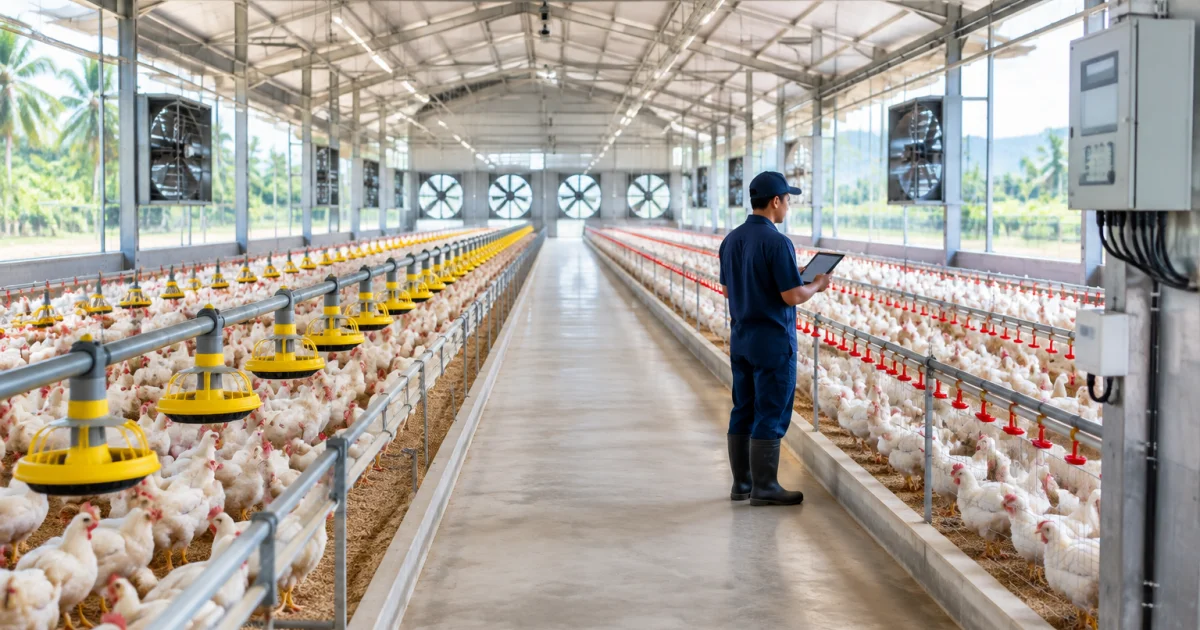
Automation in Malaysian poultry houses is shifting from “add a machine” upgrades to system planning. In 2026, layer and broiler operators are looking at how housing layout, feeding and drinking lines, egg collection, ventilation/cooling, and control logic work together.
The goal is practical: reduce labour dependence, stabilise performance, and make daily management easier in hot, humid conditions. The biggest gains often come from consistency—reliable feed delivery, clean water access, steady airflow, and gentler egg handling—rather than the most complex technology.
This guide summarises what’s changing in poultry farming equipment automation in Malaysia and how to turn those trends into an upgrade plan that fits your house type, capacity, and staffing.
1) The big shift: from standalone machines to integrated systems
Farms still automate in stages, but buyers are increasingly planning compatibility upfront. Typical questions now include:
- Will feeding layout match the cage or floor plan and allow future expansion?
- Can environmental control respond to bird age, stocking density, and weather without constant manual tweaking?
- Will egg collection minimise cracks by reducing drops and manual handling points?
- Can your team maintain it quickly with straightforward procedures and locally available spares?
Integration doesn’t mean “high-tech everything.” It means mechanical and electrical fit, plus a workflow your staff can run consistently. Planning as a system also avoids common trade-offs, such as increasing ventilation without stable drinker pressure, or speeding egg transfer without improving alignment.
What “integrated” looks like in real farm decisions
Many projects are now bundled around outcomes:
- Labour reduction bundle: automatic feeding + reliable drinking lines + simplified manure removal routing + basic controls that reduce daily checks.
- Egg quality and handling bundle (layers): cage setup + egg collection equipment + egg conveyor/elevator to reduce drops, tight turns, and carry distance.
- Heat resilience bundle: poultry fan selection + cooling pads + safety curtains + controllers to keep airflow stable.
This approach helps ensure each component can deliver its value because the supporting components aren’t missing or undersized.
2) Housing automation is getting more “layout-driven” (especially cage planning)
For layers, housing decisions increasingly start with “how easy is this to run daily?” not just “how fast can we install it?” Cage planning, aisle width, service access, and expansion options are now core parts of automation planning.
Operators also compare layouts (including multi-tier and alternative formats) based on how well they support automated feeding, drinking, egg handling, and manure management, with the aim of consistent routines and predictable maintenance access.
Choosing a chicken cage system with automation in mind
A chicken cage system sets the geometry for:
- Feed delivery: uniform distribution across tiers and rows.
- Water access: stable pressure along long lines, with simple flushing routines.
- Egg movement: smooth roll-out and transfer with minimal jolts.
- Serviceability: access to motors, belts, and wear parts without major dismantling.
In 2026, more farms specify automation-friendly details early—end-of-line service points, clear separation between bird areas and maintenance lanes, and access doors—reducing downtime and improving biosecurity discipline.
3) Feeding and feed logistics: reliability and monitoring beat sheer speed
Feeding automation is increasingly judged by stability and distribution consistency, not just whether it “moves feed.” Farms are paying closer attention to the full chain: storage, transfer routing, and delivery in the house. A good feeder line can still underperform if upstream transfer is unreliable or difficult to maintain.
Layout choices for silos/bins and auger routing matter more, especially where they affect truck access, refill routines, mess control, and safe maintenance.
What’s changing in automatic feeding system expectations
- Predictable distribution: steady feed delivery along the whole line so access is more even.
- Ease of cleaning: practical access for routine checks without specialised tools.
- Reduced spillage: better trough management and controlled delivery to cut waste and keep floors drier.
- Expandable routing: the ability to extend houses or add lines without redoing everything.
For staged upgrades, many farms now improve “hidden” reliability first—storage workflow and transfer/auger routing—before investing in faster or more advanced in-house distribution.
When scoping an upgrade, relevant references include flex auger options for transfer and the feeding and filling system category for integrated planning.
4) Water delivery and drinker lines: focusing on cleanliness, not just supply
Drinking systems look simple but are highly sensitive in daily operation. The 2026 emphasis is on line management: fewer leaks and wet spots, easier flushing, and consistent performance despite temperature swings.
In Malaysia, heat and humidity can amplify the impact of wet litter (broilers) or damp areas under cages. Improving drinker management can reduce small recurring fixes and support healthier day-to-day conditions.
What buyers look for in modern drinking systems
- Stable flow and pressure: even delivery across long lines and multiple rows.
- Low spillage design: drier floors and less cleanup.
- Maintenance access: quick replacement of wear parts and simple inspection.
- Compatible sanitation routines: practical flushing points and repeatable staff procedures.
It’s often useful to evaluate drinker upgrades together with ventilation and cooling, since airflow changes bird movement and water consumption patterns. For layers, see drinking systems for layers, including Ziggity options, when comparing configurations and service preferences.
5) Egg handling is getting more mechanised and gentler (conveyors and elevators)
In layer houses, egg handling is one of the fastest ways to reduce labour and breakage risk. The trend is not just adding belts, but designing smoother transfer paths that reduce sudden drops, misalignment, and manual carry points.
More operators plan egg handling as a complete route—from collection to transfer, conveyance, elevation (if required), and handover to packing—because each transfer is a risk point.
How egg conveyor planning is changing
As houses expand, longer distances make an egg conveyor a workflow tool, not a luxury. It can standardise handling, reduce staff fatigue, and keep throughput predictable during peak collection.
- Smoother transitions: better alignment between belts, conveyors, and transfer points.
- House-to-packing workflow: routing that matches pack room layout to avoid backtracking.
- Service-friendly design: accessible rollers and components for cleaning and maintenance.
When comparing routes and layouts, references like egg conveyor and egg elevator configurations can help you specify transfer points and elevation changes correctly.
6) Environmental control: more attention to airflow patterns and control practicality
Environmental control is often the biggest lever for consistent performance in Malaysian conditions. Instead of simply buying larger equipment, 2026 planning focuses on airflow patterns, placement, and controllability. A well-designed poultry fan setup, paired with appropriate inlets, cooling pads, and curtains, can improve stability while staying manageable to operate.
Usability is also a priority: controllers should be easy to train, support repeatable routines, and provide alarms that help diagnose issues rather than add confusion. Serviceability and reliability are part of the purchasing decision, not an afterthought.
Key checks when upgrading fans, cooling, and controls
- Fan selection and placement: aim for uniform airflow, not only strong exhaust-side flow.
- Cooling and inlet balance: match pads, inlets, and curtain management to target pressure and direction.
- Controller usability: clear settings, practical monitoring points, and straightforward training.
- Maintenance routine: access for belt checks, motor servicing, and cleaning without disrupting the house.
For layer projects, reviewing climate control options can help you map equipment choices to house length, insulation approach, and management style.
A practical buying framework for Malaysia: how to plan automation upgrades in 2026
Use this framework for new builds and retrofits to keep vendor discussions and budgeting grounded in operational outcomes.
Step 1: Define your operational bottleneck (not just your wishlist)
Start with the daily pain you need to reduce—labour hours for feeding/checking, inconsistent afternoon airflow, wet areas from drinkers, or egg handling that strains staffing and increases breakage. Choose one primary bottleneck and one secondary.
Step 2: Map the “system chain” that influences that bottleneck
Most outcomes depend on multiple connected parts. Examples:
- Egg breakage: roll-out angle + belt condition + transfer points + conveyor routing + elevation changes.
- Feed inconsistency: refill routine + transfer/auger routing + line layout + end-of-line returns + cleaning access.
- Heat stress risk: fan layout + inlets + cooling pads + curtains + controller settings + maintenance discipline.
This chain thinking is why isolated upgrades are less satisfying in 2026: performance still fails at the weakest link.
Step 3: Decide retrofit vs. staged replacement
A full replacement isn’t always necessary. Staged plans can work when sequenced logically—for example, improving feed transfer and storage before adding feeder lines, or fixing airflow consistency before fine-tuning drinker performance.
Step 4: Specify serviceability and spare strategy during purchase
Automation reduces daily labour but increases the need for planned maintenance. Ask vendors about routine service steps, expected wear parts, access requirements, and local spare availability to avoid designs that are difficult to maintain in real farm conditions.
Step 5: Commissioning and staff handover as part of the “equipment”
Many disappointments come from setup rather than hardware. Commissioning should include calibration, basic troubleshooting workflows, and clear daily checks. Training matters more in integrated systems where controller settings influence temperature, airflow, and moisture together.
Conclusion: automation choices are becoming more integrated and more practical
In Malaysia, the 2026 trend is not simply more automation—it’s better-aligned automation: housing and cage layouts that suit equipment routing, feeding and drinking systems selected for consistency and maintainability, egg handling routes built to reduce transfers, and environmental control planned around airflow patterns and usable controls.
To plan a near-term upgrade, start by mapping your bottleneck to its system chain, then choose equipment that fits your current operation and the next expansion step. That’s how automation becomes a repeatable operational advantage.
To explore layer categories as part of your planning, browse the layer equipment range and shortlist components that match your upgrade sequence.
Frequently Asked Questions
Which poultry house systems are most worth automating first for Malaysian farms?
It depends on your main bottleneck, but most farms start where labour and consistency gains are clearest: automatic feeding and drinking lines, then environmental control (fans, cooling, and controllers). Layer farms often prioritise egg handling next because egg collection equipment, conveyors, and elevators can reduce manual handling points and improve workflow reliability.
How do I choose a chicken cage system that supports automation later?
Look beyond capacity and focus on automation geometry: aisle access for maintenance, clear routing for feeding and drinking lines, smooth egg roll-out and transfer points, and a layout that can be expanded without reworking the entire house. A good cage plan makes future upgrades (egg conveyors, manure handling, or additional rows) simpler and more predictable.
What should I check before buying an automatic feeding system?
Confirm the whole feed logistics chain: storage and refill workflow, transfer routing (such as augers), distribution uniformity across rows/tiers, spillage control, and service access for cleaning and wear-part replacement. Ask how the system behaves during partial loads, restarts, and routine maintenance so daily operation stays stable.
Do egg conveyors reduce breakage, and what affects results most?
They can, especially when they reduce manual carry distance and the number of transfer points. Results depend heavily on routing design (straight paths, gentle turns, minimal drops), alignment between collection belts and conveyors, and maintenance practices such as keeping rollers and belts clean and properly tensioned.
How do ventilation fans and climate control fit into automation planning in Malaysia?
They should be planned as a complete airflow system, not just individual equipment. Fan capacity and placement must match inlets, cooling pads, and curtain management so airflow is uniform. Controllers should be easy for staff to operate, with practical settings and commissioning support to ensure temperature, humidity, and airflow targets are repeatable day to day.
Plan your next automation upgrade with Tong Seh
If you’re evaluating automation for a layer or broiler project in Malaysia, Tong Seh can help you scope a practical, integrated solution across housing and cage configurations, feeding and feed storage, drinking systems, egg handling, and environmental control. With local manufacturing capability and decades of experience since 1981, our team supports both retrofit upgrades and new build planning with equipment that’s designed for durability, usability, and maintenance-friendly operation.
Share your house layout, target capacity, and current bottlenecks, and we’ll help you map the right upgrade sequence and equipment configuration.
Disclaimer:
The information provided in this article is for general informational purposes only. Readers are encouraged to consult with a qualified professional or contact Tong Seh for advice and solutions tailored to their specific needs. While we strive to provide accurate and up-to-date information, we cannot guarantee that it is entirely error-free. Tong Seh Industries Supply Sdn Bhd (TSIS) assumes no responsibility for any errors or omissions.