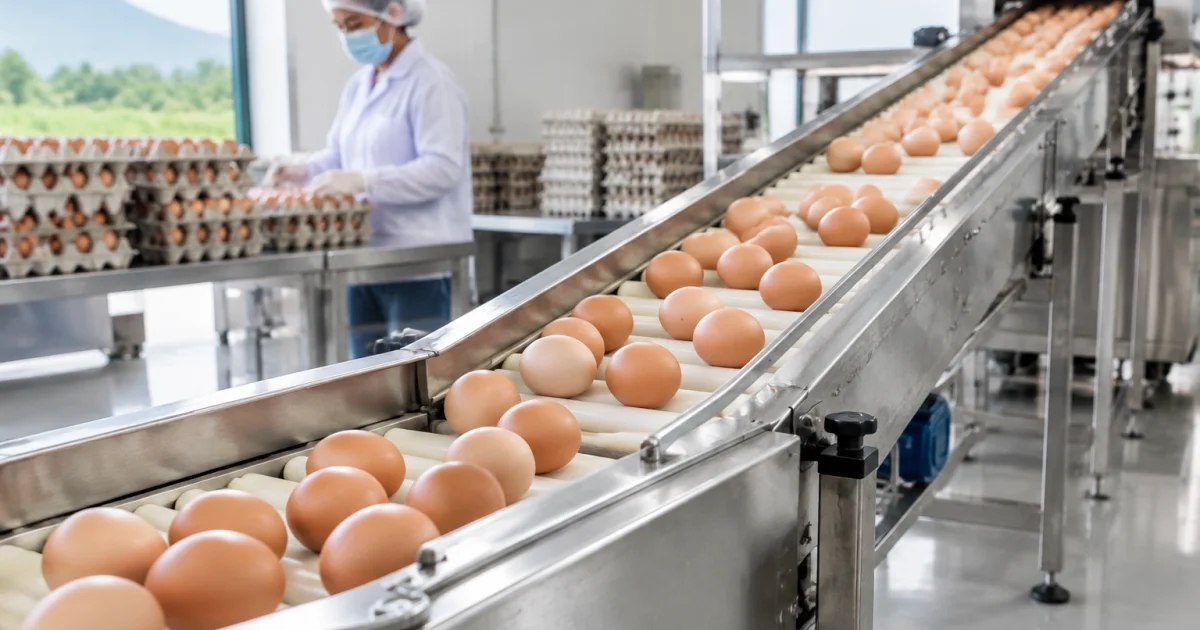
If you are new to upgrading a poultry farm, conveyors can look like “just a belt.” In practice, an industrial conveyor is core infrastructure: it links cage rows to the egg room, reduces handling and breakage, and can support internal feed movement to cut manual labour.
This guide helps you specify the right conveyor for two common jobs—egg handling (collection and transfer) and feed movement (internal transport/support for distribution). Use it as a starting checklist to compare suppliers, match your layout, and avoid problems like poor fit, difficult cleaning, or fragile transfer points.
Start with the application: eggs, feed, or both?
Begin by defining what you will move, where it starts, where it ends, and what “good performance” looks like for your team (low breakage, fewer jams, easy cleaning, predictable output).
Egg handling: gentle, clean, and low-breakage
Egg lines should prioritise controlled handling and hygiene:
- Gentle transfer points to reduce cracks (merges, drops, elevator transitions).
- Stable speed to avoid collisions and pile-ups.
- Easy-to-clean construction that won’t trap dust and feathers.
- Integration with cage-row collection and downstream steps (elevator, counting, packing).
Define the full path—from cage row outputs to the egg room entry and any vertical lift—so the supplier can design transitions, not just “a conveyor length.”
Feed movement: dust-tolerant, robust, and predictable
Feed is heavier, abrasive, and dusty. Typical priorities include:
- Capacity (kg/h or t/h) plus peak/surge conditions (start-up and refill cycles).
- Dust control and practical access for clean-out (covers, inspection points).
- Wear resistance at contact/impact zones (liners, bends, drive components).
- Safe routing around people, vehicles, and service corridors.
Many farms rely on augers, feed carts, or flex augers for distribution. If you want a conveyor in the feeding chain, describe how it bridges storage, transfer points, and distribution equipment so it is specified as part of the system.
If you want one supplier to coordinate multiple systems
To reduce integration risk, you can request a single supplier to coordinate interfaces across cages, egg handling, feeding, and related controls. This helps align heights, transfer points, guarding, and maintenance access—rather than receiving a standalone conveyor that is difficult to commission.
Know the main conveyor types used around poultry operations
You do not need deep engineering detail, but naming the conveyor type (and why it fits) makes quotations more accurate.
Roller conveyors (common for eggs)
Roller conveyors can handle eggs gently when roller spacing, speeds, and transfers are designed well. Specify roller material/spacing, curve approach, and how rollers are accessed for cleaning.
Belt conveyors (general-purpose transfer)
Belt conveyors are widely used. For eggs, choose belt type and drive control to prevent slipping or sudden acceleration. For feed, belts can suit steady transfers, especially in covered or enclosed runs.
Modular plastic belts (washdown-friendly areas)
In egg rooms or cleaner zones, modular plastic belts can simplify washdown and maintenance. If frequent washdown is expected, state cleaning chemicals and water exposure so material compatibility and corrosion protection are correct.
Elevators and vertical transfer (egg elevator integration)
When eggs change levels, the elevator is as critical as the horizontal line. Specify inlet/outlet heights, discharge direction, buffering at transitions, and “gentle handling” requirements. Planning around an egg elevator early can help the rest of the conveyor routing and heights fit from day one.
How to specify capacity, speed, and layout (without overcomplicating it)
Most issues come from unclear basics: undersized capacity, excessive speed for eggs, or routing that blocks access. Use this simple framework.
1) Define sources and destinations
List each source (for example, every cage row output) and each destination (egg room entry, sorting, packing). If multiple rows merge, specify where merging occurs and what should happen during a backup or stoppage.
2) Measure distances and height changes
Provide approximate lengths, number of turns, and elevation changes. Note constraints such as columns, doorways, low ceilings, and “no-go” zones (walkways, emergency exits, electrical rooms). This prevents a design that works on paper but fails on site.
3) Set performance targets for eggs
Define success as steady flow with minimal cracks and minimal manual intervention, not maximum speed. Ask suppliers how they manage:
- Transfer drops and impact points
- Egg spacing and collision risk
- Start/stop behaviour (soft start, controlled restart after stoppage)
Request a layout drawing that clearly marks transfer points—common sources of breakage and jams.
4) Set performance targets for feed movement
For feed, define:
- Required throughput and peak demand periods
- Feed type (mash, pellet, crumble) and its flow behaviour
- Dust levels, clean-out frequency, and whether runs must be covered/enclosed
If you use silos and transfer equipment, align conveyor requirements to your storage and delivery plan. Reviewing typical storage bin and silo systems can help you specify correct inlets/outlets, covers, and access points.
Materials, hygiene, and maintenance: write these into your specification
Do not focus only on length and motor power. Long-term performance depends on corrosion resistance, cleanability, and safe servicing.
Construction and corrosion resistance
State the installation zone (inside house, egg room, covered corridor) and exposure (humidity, washdown, chemical cleaning). Ask for suitable frame and fastener materials for those conditions.
Cleanability (especially around eggs)
For egg handling, specify design features that make cleaning realistic:
- Open, accessible frames with fewer dust-trapping ledges
- Easy access/removal for rollers or belts where feathers collect
- Drain-friendly design in washdown areas
Treat cleanability as a performance requirement, because difficult cleaning leads to hygiene drift over time.
Maintenance access and spare parts
Require safe access to drives, tensioning points, sensors, and transfer stations. Request a basic recommended spares list (wear items such as rollers, belts, sensors) to plan stock and reduce downtime.
Farm safety and people movement
Confirm where people walk and where forklifts/trolleys move. This affects guarding, covers, and routing. A service-friendly route that preserves access to cage rows and utilities is often more valuable than the shortest path.
Integration checklist: cages, egg rooms, feeding systems, and environment control
Conveyors rarely operate alone. Describing interfaces upfront makes commissioning smoother and day-to-day operation simpler.
Interface with layer cages and egg collection
Confirm how eggs exit the cages and align to the collection line. Provide row spacing, aisle width, and where eggs should converge. If you are mapping a full package, reviewing the broader poultry equipment range can help you align cages, egg handling, feeding, and environment control.
Interface with egg conveyor sections and downstream handling
Egg lines are often split into in-house collection, transfer to egg room, and onward movement. Ask where each section begins/ends, drive locations, and how jams are detected and handled. A dedicated egg conveyor overview can help you identify options you may need (curves, merges, speed control, section lengths).
Interface with feeding and filling systems
If the goal is reducing bag handling or improving transfers, document the full feed path: delivery, storage, transfer, and distribution. Specify how the conveyor connects to the overall feeding filling system solution, including inspection hatches, dust covers, and clean-out points if needed.
Environmental conditions (heat, humidity, ventilation)
Note strong airflow, humidity, and dust/feather conditions where the conveyor runs. These influence sensor placement, cleaning frequency, and component life. You do not need to redesign ventilation—just document constraints so the conveyor is specified appropriately.
A simple request-for-quotation (RFQ) template you can copy
Use this structure to keep supplier quotes comparable:
- Application: egg handling, feed movement, or both; brief process description.
- Farm layout: source/destination points, distances, turns, elevation changes, site constraints.
- Capacity targets: peak flow (eggs/hour or throughput) and operating hours.
- Product details: egg size range/handling priorities; feed type and dust considerations.
- Construction: installation zone, corrosion/washdown expectations, preferred materials.
- Integration: cage interface, elevator needs, connection to feeding systems, control preferences.
- Maintenance: access constraints, cleaning assumptions, spare parts approach.
- Deliverables: layout drawing, equipment list, recommended spares, commissioning/training scope.
Conclusion: specify the outcome, then the hardware
Conveyor specification is simpler when you start from outcomes: gentle egg handling with minimal cracks, or reliable feed transfer designed for dust and wear. Then select the conveyor type, confirm the route, and write hygiene and maintenance requirements into the specification.
Finally, treat the conveyor as part of an integrated farm system—connected to cage rows, egg handling equipment, and feeding/storage infrastructure. With a clear application description and an RFQ checklist, you can compare options confidently and choose a system that fits daily workflow, not just the floor plan.
Frequently Asked Questions
What is the best conveyor type for eggs in a layer farm?
There isn’t one “best” type for every farm. Many egg lines use roller or belt-based sections designed to keep transfers gentle and speeds stable. The right choice depends on your cage row layout, number of merges, whether you need curves or elevation changes, and how you plan to clean the system. Ask suppliers to explain how they minimise impact at transfer points and how jam detection works.
How do I estimate conveyor capacity for egg collection?
Start with peak collection periods rather than daily averages. List how many cage rows feed into the line, when eggs are collected, and where merges occur. Then ask the supplier to size the system so it can handle peak flow without frequent stops or egg pile-ups at transfer points. If the line includes an elevator, capacity must be matched across both horizontal and vertical sections.
Can an industrial conveyor be used for moving poultry feed?
Yes, in certain layouts conveyors can support feed movement between storage, transfer points, and distribution equipment. However, feed is dusty and abrasive, so the system must be specified for dust control, wear resistance, and safe clean-out. In many poultry houses, auger-based solutions are also common, so it’s important to define how the conveyor will integrate with the rest of your feeding system.
What hygiene and cleaning features should I specify for egg conveyors?
Specify easy access to rollers or belts, open frames that do not trap feathers and dust, and materials suitable for your cleaning method (dry cleaning or washdown). Also specify how the design avoids hidden ledges and how components can be removed or serviced without long downtime. Practical cleanability is a performance requirement for egg handling, not just a finishing detail.
What information should I send a supplier to get an accurate conveyor quotation?
Send a simple layout sketch with distances, turns, and elevation changes; identify source and destination points; state whether the application is egg handling, feed movement, or both; and provide capacity targets during peak operation. Include constraints such as walkway clearance, washdown expectations, and integration needs (for example, interfaces with cage rows, egg elevators, or feeding and filling systems).
Need help specifying a conveyor line for your farm layout?
Tong Seh supplies complete poultry equipment solutions—from egg handling systems (including egg conveyors and elevators) to feeding and feed storage setups. If you share your farm layout, target capacity, and cleaning/maintenance requirements, our team can help you outline a practical specification and recommend a configuration that fits your operation.
Talk to Tong Seh to plan an egg handling and feed movement system that supports automation, reduces manual work, and stays service-friendly for the long run.
Disclaimer:
The information provided in this article is for general informational purposes only. Readers are encouraged to consult with a qualified professional or contact Tong Seh for advice and solutions tailored to their specific needs. While we strive to provide accurate and up-to-date information, we cannot guarantee that it is entirely error-free. Tong Seh Industries Supply Sdn Bhd (TSIS) assumes no responsibility for any errors or omissions.